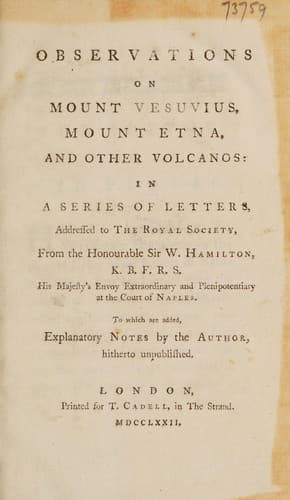
Observations on Mount Vesuvius, Mount Etna, and Other Volcanos — John Shaqi
Observations on Mount Vesuvius, Mount Etna, and Other VolcanosHamilton, William, Sir
Science
Observations on Mount Vesuvius, Mount Etna, and Other Volcanos
Hamilton, William, Sir
Etna, Mount (Italy) -- Early works to 1800; Vesuvius (Italy) -- Early works to 1800; Volcanoes -- Italy -- Early works to 1800
_The exteriour black line marks each increase & the interiour dotted
line shews the state of the little Mountain before that increase, so
that the dotted line in the Drawing of Oct 18.^{th} shews the Size of
the little Mountain July 8.^{th} the little spot A. marks where the lava
came out some days before the great Eruption. B. C. D. mark the ancient
Crater & E. the little Mountain the day before the Eruption. F. G. is
the present Crater, & the exteriour black line H. F. G. the present
shape of the top of Mount Vesuvius. Since May last the Mountain is
increased from B. to F. which is near 200 feet._]
PLATE III.
Views of the gradual increase of the little mountain within the
ancient crater; and of the present shape of Mount Vesuvius.
LETTER III.
To MATHEW MATY, M. D. Secretary to the Royal SOCIETY.
Villa Angelica, near Mount Vesuvius,
October 4, 1768.
SIR,
I have but very lately received your last obliging letter, of the 5th of
July, with the volume of Philosophical Transactions.
I must beg of you to express my satisfaction at the notice which the
Royal Society hath been pleased to take of my accounts of the two last
eruptions of Mount Vesuvius. Since I have been at my villa here, I have
enquired of the inhabitants of the mountain, after what they had seen
during the last eruption. In my letter to Lord Morton, I mentioned
nothing but what came immediately under my own observation: but as all
the peasants here agree in their account of the terrible thunder and
lightning, which lasted almost the whole time of the eruption, upon the
mountain only; I think it a circumstance worth attending to. Besides the
lightning, which perfectly resembled the common forked lightning, there
were many meteors, like what are vulgarly called _falling stars_. A
peasant, in my neighbourhood, lost eight hogs, by the ashes falling into
the trough with their food: they grew giddy, and died in a few hours.
The last day of the eruption, the ashes, which fell abundantly upon the
mountain, were as white almost as snow[14]; and the old people here
assure me, that is a sure symptom of the eruption being at an end.
These circumstances, being well attested, I thought worth relating.
Public-domain text, read in full here on John Shaqi.
Reviews
Reviews
No reviews yet
Be the first to share your thoughts on this work.
Join the Discussion
Join the discussion
Sign in to leave a comment or review.
Sign InorCreate an account