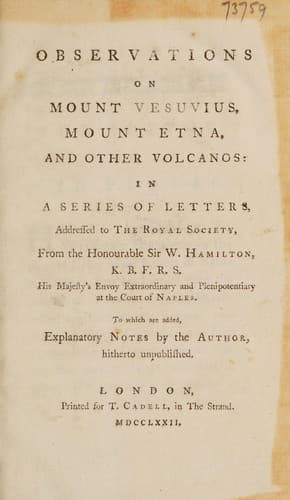
Observations on Mount Vesuvius, Mount Etna, and Other VolcanosHamilton, William, Sir
Science
Observations on Mount Vesuvius, Mount Etna, and Other Volcanos
Hamilton, William, Sir
Etna, Mount (Italy) -- Early works to 1800; Vesuvius (Italy) -- Early works to 1800; Volcanoes -- Italy -- Early works to 1800
In about four hours of gradual ascent, we arrived at a little convent of
Benedictine monks, called St. Nicolo dell' Arena, about thirteen miles
from Catania, and within a mile of the Volcano from whence issued the
last very great eruption in the year 1669; a circumstantial account of
which was sent to our court by a Lord Winchelsea, who happened to be
then at Catania in his way home, from his embassy at Constantinople. His
Lordship's account is curious, and was printed in London soon after; I
saw a copy of it at Palermo, in the library of the Prince
Torremuzzo[20]. We slept in the Benedictines convent the night of the
24th, and passed the next morning in observing the ravage made by the
abovementioned terrible eruption, over the rich country of the
Piemontese. The lava burst out of a vineyard within a mile of St.
Nicolo, and, by frequent explosions of stones and ashes, raised there a
mountain, which, as near as I can judge, having ascended it, is not less
than half a mile perpendicular in height, and is certainly at least
three miles in circumference at its basis. The lava that ran from it,
and on which there are as yet no signs of vegetation, is fourteen miles
in length, and in many parts six in breadth; it reached Catania, and
destroyed part of its walls, buried an amphitheatre, an aqueduct, and
many other monuments of its ancient grandeur, which till then had
resisted the hand of Time, and ran a considerable length into the sea,
so as to have once formed a beautiful and safe harbour; but it was soon
after filled up by a fresh torrent of the same inflamed matter: a
circumstance the Catanians lament to this day, as they are without a
port. There has been no such eruption since, though there are signs of
many, more terrible, that have preceded it.
Public-domain text, read in full here on John Shaqi.
Reviews
Reviews
No reviews yet
Be the first to share your thoughts on this work.
Join the Discussion
Join the discussion
Sign in to leave a comment or review.
Sign InorCreate an account