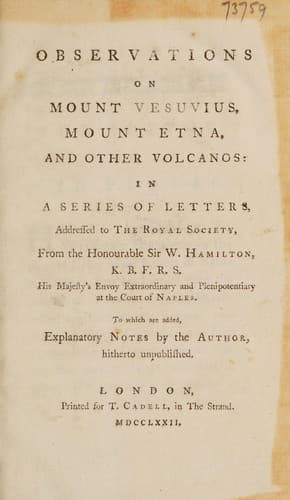
Observations on Mount Vesuvius, Mount Etna, and Other VolcanosHamilton, William, Sir
Science
Observations on Mount Vesuvius, Mount Etna, and Other Volcanos
Hamilton, William, Sir
Etna, Mount (Italy) -- Early works to 1800; Vesuvius (Italy) -- Early works to 1800; Volcanoes -- Italy -- Early works to 1800
For two or three miles round the mountain raised by this eruption, all
is barren, and covered with ashes; this ground, as well as the mountain
itself, will in time certainly be as fertile as many other mountains in
its neighbourhood, that have been likewise formed by explosion. If the
dates of these explosions could be ascertained, it would be very
curious, and mark the progress of time with respect to the return of
vegetation, as the mountains raised by them are in different states;
those which I imagine to be the most modern are covered with ashes only;
others of an older date, with small plants and herbs; and the most
ancient, with the largest timber-trees I ever saw: but I believe the
latter are so very ancient, as to be far out of the reach of history. At
the foot of the mountain, raised by the eruption of the year 1669, there
is a hole, through which, by means of a rope, we descended into several
subterraneous caverns, branching out and extending much farther and
deeper than we chose to venture; the cold there being excessive, and a
violent wind frequently extinguishing some of our torches. These caverns
undoubtedly contained the lava that issued forth, and extended, as I
said before, quite to Catania. There are many of these subterraneous
cavities known, on other parts of Etna; such as that called by the
peasants La Baracca Vecchia, another La Spelonca della Palomba (from the
wild pigeons building their nests therein), and the cavern Thalia,
mentioned by Boccaccio. Some of them are made use of as magazines for
snow; the whole island of Sicily and Malta being supplied with this
essential article (in a hot climate) from Mount Etna. Many more would be
found, I dare say, if searched for, particularly near and under the
craters from whence great lavas have issued, as the immense quantities
of such matter we see above ground, must necessarily suppose very great
hollows underneath.
Public-domain text, read in full here on John Shaqi.
Reviews
Reviews
No reviews yet
Be the first to share your thoughts on this work.
Join the Discussion
Join the discussion
Sign in to leave a comment or review.
Sign InorCreate an account