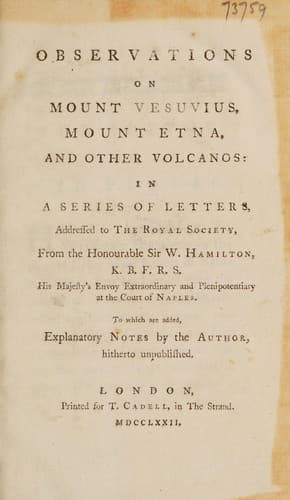
Observations on Mount Vesuvius, Mount Etna, and Other VolcanosHamilton, William, Sir
Science
Observations on Mount Vesuvius, Mount Etna, and Other Volcanos
Hamilton, William, Sir
Etna, Mount (Italy) -- Early works to 1800; Vesuvius (Italy) -- Early works to 1800; Volcanoes -- Italy -- Early works to 1800
This fracture is occasioned by the
lava's forcing its way out, which operation I have described in my
account of the last eruption of Vesuvius. Whenever I shall meet with a
mountain, in any part of the world, whose form is regularly conical,
with a hollow crater on its top, and one side broken, I shall be apt to
decide such a mountain's having been formed by an eruption; as both on
Etna and Vesuvius the mountains formed by explosion are without
exception according to this description. But to return to my narrative.
After having feasted our eyes with the glorious prospect above-mentioned
(for which, as Spartian tells us, the Emperor Adrian was at the trouble
of ascending Etna), we looked into the great crater, which, as near as
we could judge, is about two miles and a half in circumference; we did
not think it safe to go round and measure it, as some parts seemed to
be very tender ground. The inside of the crater, which is incrusted with
salts and sulphurs like that of Vesuvius, is in the form of an inverted
hollow cone, and its depth nearly answers to the height of the little
mountain that crowns the great Volcano. The smoak, issuing abundantly
from the sides and bottom, prevented our seeing quite down; but the wind
clearing away the smoak from time to time, I saw this inverted cone
contracted almost to a point; and, from repeated observations, I dare
say, that in all Volcanos, the depth of the craters will be found to
correspond nearly to the height of the conical mountains of cinders
which usually crown them; in short, I look upon the craters as a sort of
suspended funnels, under which are vast caverns and abysses. The
formation of such conical mountains with their craters are easily
accounted for, by the fall of the stones, cinders, and ashes, emitted at
the time of an eruption.
Public-domain text, read in full here on John Shaqi.
Reviews
Reviews
No reviews yet
Be the first to share your thoughts on this work.
Join the Discussion
Join the discussion
Sign in to leave a comment or review.
Sign InorCreate an account