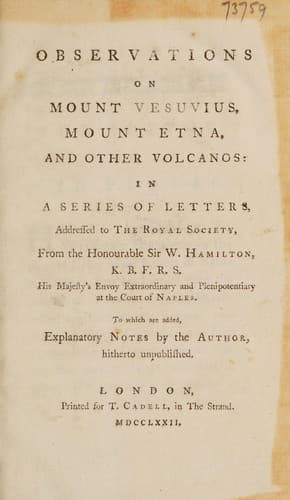
Observations on Mount Vesuvius, Mount Etna, and Other VolcanosHamilton, William, Sir
Science
Observations on Mount Vesuvius, Mount Etna, and Other Volcanos
Hamilton, William, Sir
Etna, Mount (Italy) -- Early works to 1800; Vesuvius (Italy) -- Early works to 1800; Volcanoes -- Italy -- Early works to 1800
The steep ascent, the keenness of the air,
the vapours of the sulphur, and the violence of the wind, which obliged
us several times to throw ourselves flat upon our faces to avoid being
overturned by it, made this latter part of our expedition rather
inconvenient and disagreeable. Our guide, by way of comfort, assured us,
that there was generally much more wind in the upper region at this
time.
Soon after we had seated ourselves on the highest point of Etna, the sun
arose, and displayed a scene that indeed passes all description. The
horizon lighting up by degrees, we discovered the greatest part of
Calabria, and the sea on the other side of it; the Phare of Messina, the
Lipari Islands; Stromboli, with its smoaking top, though at above
seventy miles distance, seemed to be just under our feet; we saw the
whole island of Sicily, its rivers, towns, harbours, &c. as if we had
been looking on a map. The island of Malta is low ground, and there was
a haziness in that part of the horizon, so that we could not discern
it; our guide assured us, he had seen it distinctly at other times,
which I can believe, as in other parts of the horizon, that were not
hazy, we saw to a much greater distance; besides, we had a clear view of
Etna's top from our ship, as we were going into the mouth of the harbour
of Malta some weeks before; in short, as I have since measured on a good
chart, we took in at one view a circle of above nine hundred English
miles. The pyramidal shadow of the mountain reached across the whole
island, and far into the sea on the other side. I counted from hence
forty-four little mountains (little I call them in comparison of their
mother Etna, though they would appear great any where else) in the
middle region on the Catania side, and many others on the other side of
the mountain, all of a conical form, and each having its crater; many
with timber trees flourishing both within and without their craters.
The points of those mountains that I imagine to be the most ancient are
blunted, and the craters of course more extensive and less deep than
those of the mountains formed by explosions of a later date, and which
preserve their pyramidal form entire. Some have been so far mouldered
down by time, as to have no other appearance of a crater than a sort of
dimple or hollow on their rounded tops, others with only half or a third
part of their cone standing; the parts that are wanting having mouldered
down, or perhaps been detached from them by earthquakes, which are here
very frequent. All however have been evidently raised by explosion; and
I believe, upon examination, many of the whimsical shapes of mountains
in other parts of the world would prove to have been occasioned by the
same natural operations. I observed that these mountains were generally
in lines or ridges; they have mostly a fracture on one side, the same as
in the little mountains raised by explosion on the sides of Vesuvius,
of which there are eight or nine.
Public-domain text, read in full here on John Shaqi.
Reviews
Reviews
No reviews yet
Be the first to share your thoughts on this work.
Join the Discussion
Join the discussion
Sign in to leave a comment or review.
Sign InorCreate an account