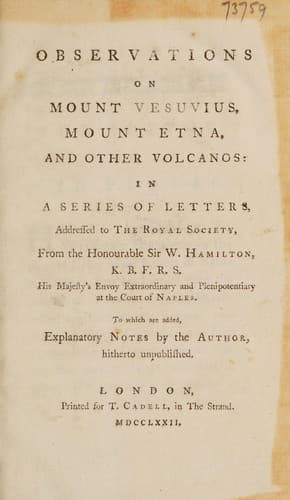
Observations on Mount Vesuvius, Mount Etna, and Other VolcanosHamilton, William, Sir
Science
Observations on Mount Vesuvius, Mount Etna, and Other Volcanos
Hamilton, William, Sir
Etna, Mount (Italy) -- Early works to 1800; Vesuvius (Italy) -- Early works to 1800; Volcanoes -- Italy -- Early works to 1800
The growth of soil by time is easily accounted for; and who, that has
visited ruins of ancient edifices, has not often seen a flourishing
shrub, in a good soil, upon the top of an old wall? I have remarked many
such on the most considerable ruins at Rome and elsewhere. But from the
soil which has grown over the barren pumice that covers Pompeii, I was
enabled to make a curious observation. Upon examining the cuts and
hollow ways made by currents of water in the neighbourhood of Vesuvius
and of other Volcanos, I had remarked that there lay frequently a
stratum of rich soil, of more or less depth, between the matter produced
by the explosion of succeeding eruptions[28]; and I was naturally led to
think, that such a stratum had grown in the same manner as the one
abovementioned over the pumice of Pompeii. Where the stratum of good
soil was thick, it was evident to me that many years had elapsed between
one eruption and that which succeeded it. I do not pretend to say, that
a just estimate can be formed of the great age of Volcanos from this
observation; but some sort of calculation might be made: for instance,
should an explosion of pumice cover again the spot under which Pompeii
is buried, the stratum of rich soil abovementioned would certainly lie
between two beds of pumice; and if a like accident had happened a
thousand years ago, the stratum of rich soil would as certainly have
wanted much of its present thickness, as the rotting of vegetables,
manure, &c. is ever increasing a cultivated soil. Whenever I find then a
succession of different strata of pumice and burnt matter, like that
which covers Pompeii, intermixed with strata of rich soil, of greater or
less depth, I hope I may be allowed reasonably to conclude, that the
whole has been the production of a long series of eruptions, occasioned
by subterraneous fire. By the size and weight of the pumice, and
fragments of burnt erupted matter in these strata, it is easy to trace
them up to their source, which I have done more than once in the
neighbourhood of Puzzole, where explosions have been frequent. The
gradual decrease in the size and quantity of the erupted matter in the
stratum abovementioned, from Pompeii to Castle-a-Mare, is very visible:
at Pompeii, as I said before, I have found them of eight pounds weight,
when at Castle-a-Mare the largest do not weigh an ounce.
Public-domain text, read in full here on John Shaqi.
Reviews
Reviews
No reviews yet
Be the first to share your thoughts on this work.
Join the Discussion
Join the discussion
Sign in to leave a comment or review.
Sign InorCreate an account