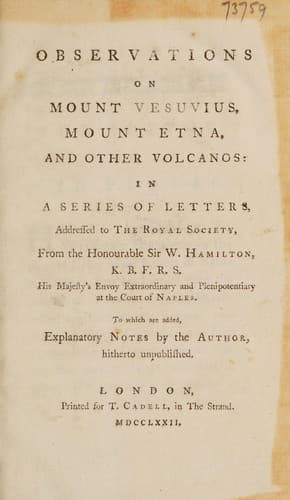
Observations on Mount Vesuvius, Mount Etna, and Other VolcanosHamilton, William, Sir
Science
Observations on Mount Vesuvius, Mount Etna, and Other Volcanos
Hamilton, William, Sir
Etna, Mount (Italy) -- Early works to 1800; Vesuvius (Italy) -- Early works to 1800; Volcanoes -- Italy -- Early works to 1800
The matter which covers the ancient town of Herculaneum is not the
produce of one eruption only; for there are evident marks that the
matter of six eruptions has taken its course over that which lies
immediately above the town, and was the cause of its destruction. These
strata are either of lava or burnt matter, with veins of good soil
between them. The stratum of erupted matter that immediately covers the
town, and with which the theatre and most of the houses were filled, is
not of that foul vitrified matter, called lava, but of a sort of soft
stone, composed of pumice, ashes, and burnt matter. It is exactly of
the same nature with what is called here the Naples stone; the Italians
distinguish it by the name of _tufa_, and it is in general use for
building. Its colour is usually that of our free stone, but sometimes
tinged with grey, green, and yellow; and the pumice stones, with which
it ever abounds, are sometimes large, and sometimes small: it varies
likewise in its degree of solidity.
The chief article in the composition of _tufa_ seems to me to be, that
fine burnt material, which is called _puzzolane_, whose binding quality
and utility by way of cement are mentioned by Vitruvius[29], and which
is to be met with only in countries that have been subject to
subterraneous fires. It is, I believe, a sort of lime prepared by
nature. This, mixed with water, great or small pumice stones, fragments
of lava, and burnt matter, may naturally be supposed to harden into a
stone of this kind[30]; and, as water frequently attends eruptions of
fire, as will be seen in the accounts I shall give of the formation of
the new mountain near Puzzole, I am convinced the first matter that
issued from Vesuvius, and covered Herculaneum, was in the state of
liquid mud. A circumstance strongly favouring my opinion is, that, about
two years ago, I saw the head of an antique statue dug out of this
matter within the theatre of Herculaneum; the impression of its face
remains to this day in the _tufa_, and might serve as a mould for a cast
in plaister of Paris, being as perfect as any mould I ever saw. As much
may be inferred from the exact resemblance of this matter, or _tufa_,
which immediately covers Herculaneum, to all the _tufas_ of which the
high grounds of Naples and its neighbourhood are composed. I detached a
piece of it sticking to, and incorporated with, the painted stucco of
the inside of the theatre of Herculaneum, and shall send it for your
inspection[31]. It is very different, as you will see, from the
vitrified matter called lava, by which it has been generally thought
that Herculaneum was destroyed. The village of Resina and some villas
stand at present above this unfortunate town.
Public-domain text, read in full here on John Shaqi.
Reviews
Reviews
No reviews yet
Be the first to share your thoughts on this work.
Join the Discussion
Join the discussion
Sign in to leave a comment or review.
Sign InorCreate an account