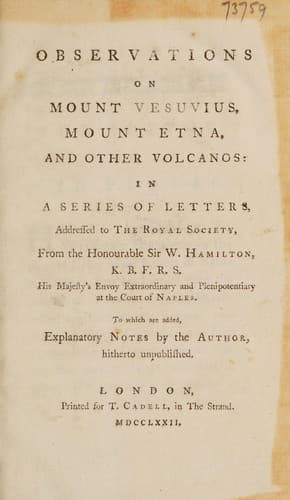
Observations on Mount Vesuvius, Mount Etna, and Other VolcanosHamilton, William, Sir
Science
Observations on Mount Vesuvius, Mount Etna, and Other Volcanos
Hamilton, William, Sir
Etna, Mount (Italy) -- Early works to 1800; Vesuvius (Italy) -- Early works to 1800; Volcanoes -- Italy -- Early works to 1800
You have now, Sir, before you the nature of the soil, from Caprea to
Naples. The soil on which this great metropolis stands has been
evidently produced by explosions, some of which seem to have been upon
the very spot on which this city is built; all the high grounds round
Naples, Pausilipo, Puzzole, Baia, Misenum, the islands of Procita and
Ischia, appear to have been raised by explosion. You can trace still in
many of these heights the conical shape that was naturally given them at
first, and even the craters out of which the matter issued, though to be
sure others of these heights have suffered such changes by the hand of
time, that you can only conjecture that they were raised in the like
manner, by their composition being exactly the same as that of those
mountains which still retain their conical form and craters entire. A
_tufa_, exactly resembling the specimen I took from the inside of the
theatre of Herculaneum, layers of pumice intermixed with layers of good
soil, just like those over Pompeii, and lavas like those of Vesuvius,
compose the whole soil of the country that remains to be described.
The famous grotto anciently cut through the mountain of Pausilipo, to
make a road from Naples to Puzzole, gives you an opportunity of seeing
that the whole of that mountain is _tufa_. The first evident crater you
meet with, after you have passed the grotto of Pausilipo, is now the
lake of Agnano; a small remain of the subterraneous fire (which must
probably have made the bason for the lake, and raised the high grounds
which form a sort of amphitheatre round it) serves to heat rooms, which
the Neapolitans make great use of in summer, for carrying off diverse
disorders, by a strong perspiration. This place is called the Sudatorio
di San Germano; near the present bagnios, which are but poor little
hovels, there are the ruins of a magnificent ancient bath. About an
hundred paces from hence is the Grotto del Cane; I shall only mention,
as a further proof of the probability that the lake of Agnano was a
Volcano, that vapours of a pernicious quality, as that in the Grotto
del Cane, are frequently met with in the neighbourhood of Etna and
Vesuvius, particularly at the time of, before, and after, great
eruptions. The noxious vapour having continued in the same force
constantly so many ages, as it has done in the Grotto del Cane (for
Pliny mentions this Grotto[35]), is indeed a circumstance in which it
differs from the vapours near Vesuvius and Etna, which are not constant.
The cone forming the outside of this supposed Volcano is still perfect
in many parts.
Public-domain text, read in full here on John Shaqi.
Reviews
Reviews
No reviews yet
Be the first to share your thoughts on this work.
Join the Discussion
Join the discussion
Sign in to leave a comment or review.
Sign InorCreate an account