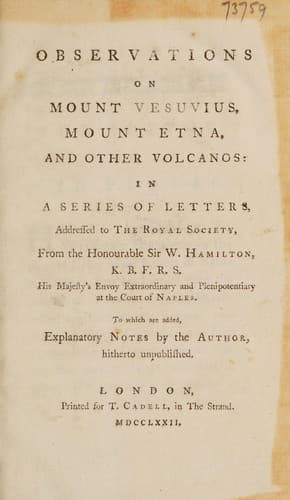
Observations on Mount Vesuvius, Mount Etna, and Other Volcanos — John Shaqi
Observations on Mount Vesuvius, Mount Etna, and Other VolcanosHamilton, William, Sir
Science
Observations on Mount Vesuvius, Mount Etna, and Other Volcanos
Hamilton, William, Sir
Etna, Mount (Italy) -- Early works to 1800; Vesuvius (Italy) -- Early works to 1800; Volcanoes -- Italy -- Early works to 1800
The soil of the Campagna Felice is very fertile; I saw the earth opened
in many places last year in the midst of that plain, when they were
seeking for materials to mend the road from Naples to Caserta. The
stratum of good soil was in general four or five feet thick; under which
was a deep stratum of cinders, pumice, fragments of lava, and such burnt
matter as abounds near Vesuvius and all Volcanos. The mountains at the
back of Caserta are mostly of a sort of lime-stone, and very different
from those formed by fire; though Signior Van Vitelli, the celebrated
architect, has assured me, that, in the cutting of the famous aqueduct
of Caserta through these mountains, he met with some soils, that had
been evidently formed by subterraneous fire. The high grounds, which
extend from Castel-a-Mare, to the point of Minerva towards the island of
Caprea, and from the promontory that divides the bay of Naples from that
of Salerno, are of lime-stone. The plain of Sorrento, that is bounded by
these high grounds, beginning at the village of Vico, and ending at that
of Massa, is wholly composed of the same sort of _tufa_ as that about
Naples, except that the cinders or pumice stones intermixed in it are
larger than in the Naples _tufa_. I conceive then that there has been an
explosion in this spot from the bottom of the sea. This plain, as I have
remarked to be the case with all soils produced by subterraneous fire,
is extremely fertile; whilst the ground about it, being of another
nature, is not so. The island of Caprea does not shew any signs of
having been formed by subterraneous fire; but is of the same nature as
the high grounds last mentioned, from which it has been probably
detached by earthquakes, or the violence of the waves. Rovigliano, an
island, or rather a rock, in the bay of Castel-a-Mare, is likewise of
lime-stone, and seems to have belonged to the original mountains in its
neighbourhood: in some of these mountains there are also petrified fish
and fossil shells, which I never have found in the mountains which I
suppose to have been formed by explosion[34].
Public-domain text, read in full here on John Shaqi.
Reviews
Reviews
No reviews yet
Be the first to share your thoughts on this work.
Join the Discussion
Join the discussion
Sign in to leave a comment or review.
Sign InorCreate an account