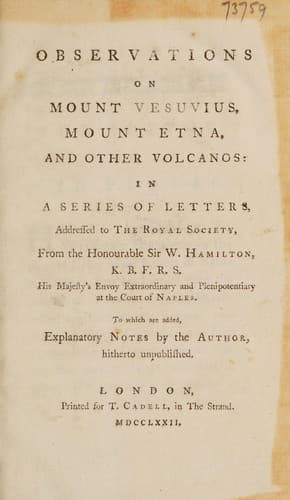
Observations on Mount Vesuvius, Mount Etna, and Other VolcanosHamilton, William, Sir
Science
Observations on Mount Vesuvius, Mount Etna, and Other Volcanos
Hamilton, William, Sir
Etna, Mount (Italy) -- Early works to 1800; Vesuvius (Italy) -- Early works to 1800; Volcanoes -- Italy -- Early works to 1800
I have observed in the lava of Vesuvius and Etna, as in this, that the
bottom, as well as the surface of it, was rough and porous, like the
cinders or scoriae from an iron foundery; and that for about a foot from
the surface and from the bottom, they were not near so solid and
compact as towards the centre; which must undoubtedly proceed from the
impression of the air upon the vitrified matter whilst in fusion. I
mention this circumstance, as it may serve to point out true lavas with
more certainty. The ancient name of the Solfaterra was, _Forum Vulcani_;
a strong proof of its origin from subterraneous fire. The degree of
heat, that the Solfaterra has preserved for so many ages, seems to have
calcined the stones upon its cone, and in its crater, as they are very
white, and crumble easily in the hottest parts.
We come next to the new mountain near Puzzole, which, being of so very
late a formation, preserves its conical shape entire, and produces as
yet but a very slender vegetation. It has a crater almost as deep as the
cone is high, which may be near a quarter of a mile perpendicular, and
is in shape a regular inverted cone. At the basis of this new mountain
(which is more than three miles in circumference), the sand upon the
sea shore, and even that which is washed by the sea itself, is burning
hot for above the space of an hundred yards; if you take up a handful of
the sand below water, you are obliged to get rid of it directly, on
account of its intense heat.
I had been long very desirous of meeting with a good account of the
formation of this new mountain, because, proving this mountain to have
been raised by mere explosion in a plain, would prove at the same time,
that all the neighbouring mountains, which are composed of the same
materials, and have exactly or in part the same form, were raised in the
like manner; and that the seat of fire, the cause of these explosions,
lies deep; which I have every reason to think.
Fortunately, I lately found two very good accounts of the phaenomena that
attended the explosion, which formed the new mountain, published a few
months after the event. As I think them very curious, and greatly to my
purpose, and as they are rare, I will give you a literal translation of
such extracts as relate to the formation of the Monte Nuovo. They are
bound in one volume[37].
The title of the first is, _Dell Incendio di Pozzuolo, Marco Antonio
delli Falconi all Illustrissima Signiora Marchesa della Padula nel
MDXXXVIII_.
At the head of the second is, _Ragionamento del Terremoto, del Nuovo
Monte, del Aprimento di Terra in Pozzuolo nell' Anno 1538, e della
significatione d'essi. Per Piero Giacomo da Toledo_; and at the end of
the book, _Stampata in Nap. per Giovanni Sulztbach Alemano, a 22di
Genaro 1539, con gratia, e privilegio_.
Public-domain text, read in full here on John Shaqi.
Reviews
Reviews
No reviews yet
Be the first to share your thoughts on this work.
Join the Discussion
Join the discussion
Sign in to leave a comment or review.
Sign InorCreate an account