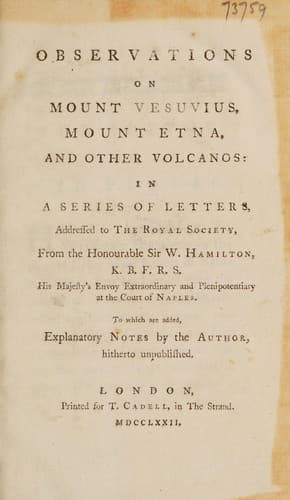
Observations on Mount Vesuvius, Mount Etna, and Other VolcanosHamilton, William, Sir
Science
Observations on Mount Vesuvius, Mount Etna, and Other Volcanos
Hamilton, William, Sir
Etna, Mount (Italy) -- Early works to 1800; Vesuvius (Italy) -- Early works to 1800; Volcanoes -- Italy -- Early works to 1800
"First then (says Marco Antonio delli Falconi), will I relate simply and
exactly the operations of nature, of which I was either myself an
eye-witness, or as they were related to me by those who had been
witnesses of them. It is now two years that there have been frequent
earthquakes at Pozzuolo, at Naples, and the neighbouring parts; on the
day and in the night before the appearance of this eruption, above
twenty shocks great and small were felt at the abovementioned places.
The eruption made its appearance the 29th of September 1538, the feast
of St. Michael the angel; it was on a Sunday, about an hour in the
night; and, as I have been informed, they began to see on that spot,
between the hot baths or sweating rooms, and Trepergule, flames of fire,
which first made their appearance at the baths, then extended towards
Trepergule, and fixing in the little valley that lies between the Monte
Barbaro and the hillock called del Pericolo (which was the road to the
lake of Avernus and the baths), in a short time the fire increased to
such a degree, that it burst open the earth in this place, and threw up
so great a quantity of ashes and pumice stones mixed with water, as
covered the whole country; and in Naples a shower of these ashes and
water fell a great part of the night. The next morning, which was
Monday, and the last of the month, the poor inhabitants of Pozzuolo,
struck with so horrible a sight, quitted their habitations, covered with
that muddy and black shower, which continued in that country the whole
day, flying death, but with faces painted with its colours; some with
their children in their arms, some with sacks full of their goods;
others leading an ass, loaded with their frightened family, towards
Naples; others carrying quantities of birds of various sorts, that had
fallen dead at the time the eruption began; others again with fish which
they had found, and were to be met with in plenty upon the shore, the
sea having been at that time considerably dried up. Don Pedro di Toledo,
Viceroy of the kingdom, with many gentlemen, went to see so wonderful
an appearance; I also, having met with the most honourable and
incomparable gentleman, Signior Fabritio Moramaldo, on the road, went
and saw the eruption and the many wonderful effects of it. The sea
towards Baia had retired a considerable way; though, from the quantity
of ashes and broken pumice stones thrown up by the eruption, it appeared
almost totally dry. I saw likewise two springs in those
lately-discovered ruins, one before the house that was the Queen's, of
hot and salt water; the other of fresh and cold water, on the shore,
about 250 paces nearer to the eruption: some say, that, still nearer to
the spot where the eruption happened, a stream of fresh water issued
forth like a little river. Turning towards the place of the eruption,
you saw mountains of smoak, part of which was very black and part very
white, rise up to a great height; and in the midst of the smoak, at
Public-domain text, read in full here on John Shaqi.
Reviews
Reviews
No reviews yet
Be the first to share your thoughts on this work.
Join the Discussion
Join the discussion
Sign in to leave a comment or review.
Sign InorCreate an account