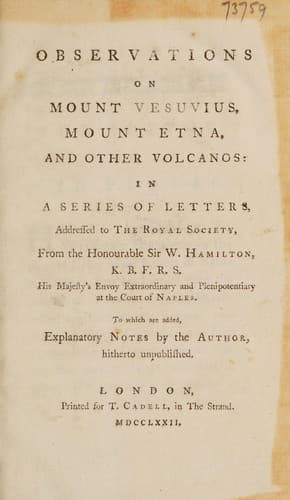
Observations on Mount Vesuvius, Mount Etna, and Other VolcanosHamilton, William, Sir
Science
Observations on Mount Vesuvius, Mount Etna, and Other Volcanos
Hamilton, William, Sir
Etna, Mount (Italy) -- Early works to 1800; Vesuvius (Italy) -- Early works to 1800; Volcanoes -- Italy -- Early works to 1800
lake of Avernus, West to the Sudatory, and joining East to the foot of
the Monte Barbaro; so that this place has changed its form and face in
such a manner as not to be known again: a thing almost incredible, to
those who have not seen it, that in so short a time so considerable a
mountain could have been formed. On its summit there is a mouth in the
form of a cup, which may be a quarter of a mile in circumference, though
some say it is as large as our market-place at Naples, from which there
issues a constant smoak; and though I have seen it only at a distance,
it appears very great. The Sunday following, which was the 6th of
October, many people going to see this phaenomenon, and some having
ascended half the mountain, others more, about 22 o'clock there happened
so sudden and horrid an eruption, with so great a smoak, that many of
these people were stifled, some of which could never be found. I have
been told, that the number of the dead or lost amounted to twenty-four.
From that time to this, nothing remarkable happened; it seems as if the
eruption returned periodically, like the ague or gout. I believe
henceforward it will not have such force, though the eruption of the
Sunday was accompanied with showers of ashes and water, which fell at
Naples, and were seen to extend as far as the mountain of Somma, called
Vesuvius by the ancients; and, as I have often remarked, the clouds of
smoak proceeding from the eruption moved in a direct line towards that
mountain, as if these places had a correspondence and connection one
with the other. In the night, many beams and columns of fire were seen
to proceed from this eruption, and some like flashes of lightning[38].
We have then, many circumstances for our observation, the earthquakes,
the eruption, the drying up of the sea, the quantity of dead fish and
birds, the birth of springs, the shower of ashes with water and without
water, the innumerable trees in that whole country, as far as the Grotto
of Lucullus, torn from their roots, thrown down, and covered with ashes,
that it gave one pain to see them: and as all these effects were
produced by the same cause that produces earthquakes; let us first
enquire how earthquakes are produced, and from thence we may easily
comprehend the cause of the abovementioned events." Then follows a
dissertation on earthquakes, and some curious conjectures relative to
the phaenomena which attended this eruption, clearly and well expressed,
considering, as the author himself apologizes, that at that time the
Italian language had been little employed on such subjects.
Public-domain text, read in full here on John Shaqi.
Reviews
Reviews
No reviews yet
Be the first to share your thoughts on this work.
Join the Discussion
Join the discussion
Sign in to leave a comment or review.
Sign InorCreate an account