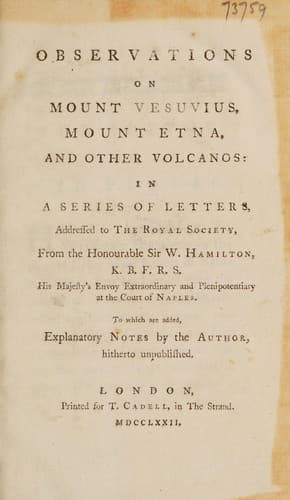
Observations on Mount Vesuvius, Mount Etna, and Other VolcanosHamilton, William, Sir
Science
Observations on Mount Vesuvius, Mount Etna, and Other Volcanos
Hamilton, William, Sir
Etna, Mount (Italy) -- Early works to 1800; Vesuvius (Italy) -- Early works to 1800; Volcanoes -- Italy -- Early works to 1800
The account of the formation of the Monte Nuovo, by Pietro Giacomo di
Toledo, is given in a dialogue between the feigned personages of
Peregrino and Svessano; the former of which says, "It is now two years
that this province of Campagna has been afflicted with earthquakes, the
country about Pozzuolo much more so than any other parts; but the 27th
and the 28th of the month of September last, the earthquakes did not
cease day or night, in the abovementioned city of Pozzuolo; that plain,
which lies between the lake of Averno, the Monte Barbaro, and the sea,
was raised a little, and many cracks were made in it, from some of which
issued water; and at the same time the sea, which was very near the
plain, dried up about two hundred paces, so that the fish were left on
the sand, a prey to the inhabitants of Pozzuolo. At last, on the 29th of
the said month, about two hours in the night, the earth opened near the
lake, and discovered a horrid mouth, from which were vomited furiously,
smoak, fire, stones, and mud composed of ashes; making, at the time of
its opening, a noise like very loud thunder: the fire, that issued from
this mouth, went towards the walls of the unfortunate city; the smoak
was partly black and partly white; the black was darker than darkness
itself, and the white was like the whitest cotton: these smoaks, rising
in the air, seemed as if they would touch the vault of heaven; the
stones that followed were, by the devouring flames, converted to pumice,
the size of which (of some I say) were much larger than an ox. The
stones went about as high as a cross-bow can carry, and then fell down,
sometimes on the edge, and sometimes into the mouth itself. It is very
true that many of them in going up could not be seen, on account of the
dark smoak; but, when they returned from the smoaky heat, they shewed
plainly where they had been, by their strong smell of fetid sulphur,
just like stones that have been thrown out of a mortar, and have passed
through the smoak of inflamed gunpowder. The mud was of the colour of
ashes, and at first very liquid, then by degrees less so; and in such
quantities, that in less than twelve hours, with the help of the
abovementioned stones, a mountain was raised of a thousand paces in
height. Not only Pozzuolo and the neighbouring country was full of this
mud, but the city of Naples also, the beauty of whose palaces were, in a
great measure, spoiled by it. The ashes were carried as far as Calabria
by the force of the winds, burning up in their passage the grass and
high trees, many of which were borne down by the weight of them. An
infinity of birds also, and numberless animals of various kinds, covered
with this sulphureous mud, gave themselves up a prey to man. Now this
eruption lasted two nights and two days without intermission, though, it
is true, not always with the same force, but more or less: when it was
at its greatest height, even at Naples you heard a noise or thundering
Public-domain text, read in full here on John Shaqi.
Reviews
Reviews
No reviews yet
Be the first to share your thoughts on this work.
Join the Discussion
Join the discussion
Sign in to leave a comment or review.
Sign InorCreate an account