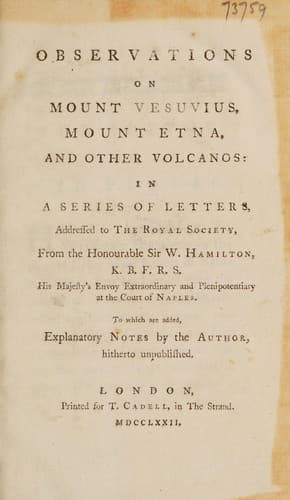
Observations on Mount Vesuvius, Mount Etna, and Other VolcanosHamilton, William, Sir
Science
Observations on Mount Vesuvius, Mount Etna, and Other Volcanos
Hamilton, William, Sir
Etna, Mount (Italy) -- Early works to 1800; Vesuvius (Italy) -- Early works to 1800; Volcanoes -- Italy -- Early works to 1800
There is no spot, I believe, that could afford a more ample field for
curious observations, than the island of Ischia, called Enaria, Inarime,
and Pithecusa, by the ancients. I have visited it three times; and this
summer passed three weeks there, during which time I examined, with
attention, every part of it. Ischia is eighteen miles in circumference:
the whole of its soil is the same as that near Vesuvius, Naples, and
Puzzole. There are numberless springs, hot, warm, and cold[41],
dispersed over the whole island, the waters of which are impregnated
with minerals of various sorts; so that, if you give credit to the
inhabitants of the country, there is no disorder but what finds its
remedy here. In the hot months (the season for making use of these
baths), those who have occasion for them flock hither from Naples. A
charitable institution sends and maintains three hundred poor patients
at the baths of Gurgitelli every season. By what I could learn of these
poor patients, those baths have really done wonders, in cases attended
with obstinate tumours, and in contractions of the tendons and muscles.
The patient begins by bathing, and then is buried in the hot sand near
the sea. In many parts of the island, the sand is burning hot, even
under water. The sand on some parts of the shore is almost entirely
composed of particles of iron ore; at least they are attracted by the
load-stone, as I have experienced. Near that part of the island called
Lacco, there is a rock of an ancient lava, forming a small cavern, which
is shut up with a door; this cavern is made use of to cool liquors and
fruit, which it does in a short time as effectually as ice. Before the
door was opened, I felt the cold to my legs very sensibly; but when it
was opened, the cold rushed out so as to give me pain; and within the
grotto it was intolerable. I was not sensible of wind attending this
cold; though upon Mount Etna and Mount Vesuvius, where there are caverns
of this kind, the cold is evidently occasioned by a subterraneous wind:
the natives call such places _ventaroli_. May not the quantity of nitre,
with which all these places abound, account in some measure for such
extreme cold? My thermometer was unluckily broken, or I would have
informed you of the exact degree of the cold in this _ventaroli_ of
Ischia, which is by much the strongest in its effects I ever felt. The
ancient lavas of Ischia shew, that the eruptions there have been very
formidable; and history informs us, that its first inhabitants were
driven out of the island by the frequency and the violence of them.
There are some of these ancient lavas not less than two hundred feet in
depth. The mountain of St. Nicola, on which there is at present a
convent of hermits, was called by the ancients Epomeus; it is as high,
if not higher, than Vesuvius, and appears to me to be a section of the
cone of the ancient and principal Volcano of the island, its composition
being all _tufa_ or lava.
Public-domain text, read in full here on John Shaqi.
Reviews
Reviews
No reviews yet
Be the first to share your thoughts on this work.
Join the Discussion
Join the discussion
Sign in to leave a comment or review.
Sign InorCreate an account