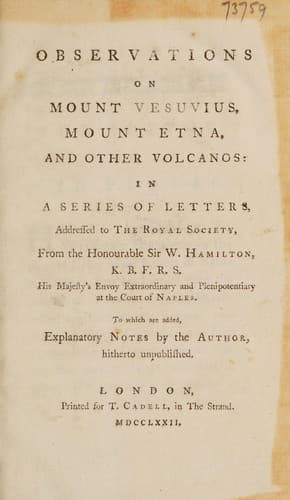
Observations on Mount Vesuvius, Mount Etna, and Other Volcanos — John Shaqi
Observations on Mount Vesuvius, Mount Etna, and Other VolcanosHamilton, William, Sir
Science
Observations on Mount Vesuvius, Mount Etna, and Other Volcanos
Hamilton, William, Sir
Etna, Mount (Italy) -- Early works to 1800; Vesuvius (Italy) -- Early works to 1800; Volcanoes -- Italy -- Early works to 1800
Virgil and other ancient authors say, that birds could not fly with
safety over the lake of Avernus, but that they fell therein; a
circumstance favouring my opinion, that this was once the mouth of a
Volcano. The vapour of the sulphur and other minerals must undoubtedly
have been more powerful, the nearer we go back to the time of the
explosion of the Volcano; and I am convinced that there are still some
remains of those vapours upon this lake, as I have observed there are
very seldom any water-fowl upon it; and that when they do go there, it
is but for a short time; whilst all the other lakes in the neighbourhood
are constantly covered with them, in the winter season. Upon Mount
Vesuvius, in the year 1766, during an eruption, when the air was
impregnated with noxious vapours, I have myself picked up dead birds
frequently.
The castle of Baia stands upon a considerable eminence, composed of the
usual _tufa_ and strata of pumice and ashes; from which I concluded I
should find some remains of the craters from whence the matter issued:
accordingly, having ascended the hill, I soon discovered two very
visible craters, just behind the castle.
The lake called the Mare-morto was also, most probably, the crater, from
whence issued the materials which formed the Promontory of Misenum, and
the high grounds around this lake. Under the ruins of an ancient
building, near the point of Misenum, in a vault, there is a vapour, or
_mofete_, exactly similar in its effects to that of the Grotto del Cane,
as I have often experienced.
The form of the little island of Nisida shews plainly its origin[40]. It
is half a hollow cone of a Volcano cut perpendicularly; the half crater
forms a little harbour called the Porto Pavone; I suppose the other half
of the cone to have been detached into the sea by earthquakes, or
perhaps by the violence of the waves, as the part that is wanting is the
side next to the open sea.
The fertile and pleasant island of Procita shews also most evident signs
of its production by explosion, the nature of its soil being directly
similar to that of Baia and Puzzole; this island seems really, as was
imagined by the ancients, to have been detached from the neighbouring
island of Ischia.
Public-domain text, read in full here on John Shaqi.
Reviews
Reviews
No reviews yet
Be the first to share your thoughts on this work.
Join the Discussion
Join the discussion
Sign in to leave a comment or review.
Sign InorCreate an account