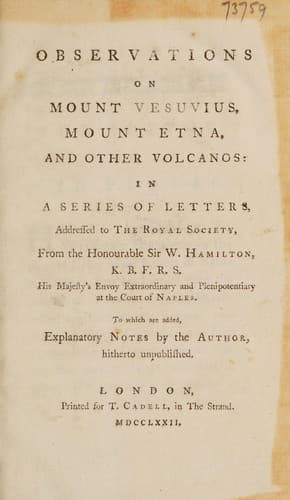
Observations on Mount Vesuvius, Mount Etna, and Other VolcanosHamilton, William, Sir
Science
Observations on Mount Vesuvius, Mount Etna, and Other Volcanos
Hamilton, William, Sir
Etna, Mount (Italy) -- Early works to 1800; Vesuvius (Italy) -- Early works to 1800; Volcanoes -- Italy -- Early works to 1800
[23] This passage, in Cornelius Severus's poem upon Etna, seems to
confirm my opinion:
"Placantesque etiam caelestia numina thure
"Summo cerne jugo, vel qua liberrimus AEtna
"Improspectus hiat; tantarum semina rerum
"Si nihil irritet flammas, stupeatque profundum."
[24] A better account of the formation of _tufa_ will be seen in my next
letter.
[25] The dates of the eruptions of Mount Etna, recorded by history, are
as follows: Before the Christian aera four, in the years 3525. 3538.
3554. 3843. After Christ, twenty-seven have been recorded, 1175. 1285.
1321. 1323. 1329. 1408. 1530. 1536. 1537. 1540. 1545. 1554. 1556. 1566.
1579. 1614. 1634. 1636. 1643. 1669. 1682. 1689. 1692. 1702. 1747. 1755.
1766.
The dates of the eruptions of Vesuvius are as follows: After Christ--79.
203. 472. 512. 685. 993. 1036. 1043. 1048. 1136. 1506. [1538, the
eruption at Puzzole.] 1631. 1660. 1682. 1694. 1701. 1704. 1712. 1717.
1730. 1737. 1751. 1754. 1760. 1766. 1767. 1770. 1771.
[26] Pliny, in his account of these islands, in the IX chapter of the
third book of his Natural History, seems to confirm this opinion.
"Lipara cum civium Romanorum oppido, dicta a Liparo rege, qui successit
AEolo, antea Melogonis vel Meliganis vocitata, abest XII millia pass. ab
Italia, ipsa circuitu paulo minori. Inter hanc et Siciliam altera, antea
Therasia appellata, nunc Hiera; qui sacra Vulcano est, colle in ea
nocturnas evomente flammas. Tertia Strongyle, a Lipara millia passuum ad
exortum solis vergens, in qua regnavit AEolus, quae a Lipara liquidiore
flamma tantum differt: e cujus fumo equinam flaturi sint venti, in
triduum praedicere incolae traduntur; unde ventos AEolo paruisse
existimatum. Quarta Didyme, minor quam Lipara. Quinta Ericusa; sexta
Phoenicusa; pabulo proximarum relicta. NOVISSIMA, eademque Minima,
Evonymos."
[27] See Plate V.
[28] The Abate Giulio Cesare Bruccini describes very elegantly, in his
account of the eruption of Vesuvius in 1631, his having made an
observation of the like nature--his words are (after having
particularized the different strata of erupted matter lying one over
another)--"parendo appunto che la natura ci abbia voluto lasciare
scritto in questa terra tutti gli incendii memorabili raccontati delli
autori."
[29] These are his words, book II. chap. vi.
"De Pulvere Puteolano.
Public-domain text, read in full here on John Shaqi.
Reviews
Reviews
No reviews yet
Be the first to share your thoughts on this work.
Elsewhere in the archive
Join the Discussion
Join the discussion
Sign in to leave a comment or review.
Sign InorCreate an account