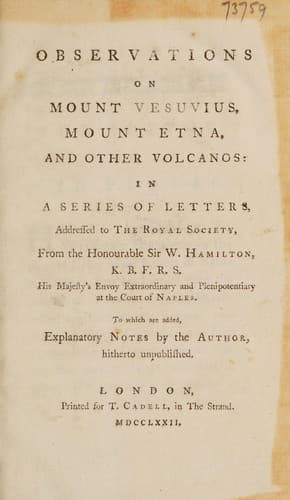
Observations on Mount Vesuvius, Mount Etna, and Other VolcanosHamilton, William, Sir
Science
Observations on Mount Vesuvius, Mount Etna, and Other Volcanos
Hamilton, William, Sir
Etna, Mount (Italy) -- Early works to 1800; Vesuvius (Italy) -- Early works to 1800; Volcanoes -- Italy -- Early works to 1800
"Est etiam genus pulveris, quod efficit naturaliter res admirandas.
Nascitur in regionibus Baianis, et in agris municipiorum, quae sunt circa
Vesuvium montem, quod commixtum cum calce et caemento non modo caeteris
aedificiis praestat firmitates, sed etiam moles, quae construuntur in mari,
sub aqua solidescunt. Hoc autem fieri hac ratione videtur, quod sub his
montibus et terra ferventes sunt fontes crebri, qui non essent, si non
in imo haberent, aut de sulfure, aut alumine, aut bitumine ardentes
maximos ignes: igitur penitus ignis, et flammae vapor per intervenia
permanans et ardens, efficet levem eam terram, et ibi, qui nascitur
tophus, exugens est, et sine liquore. Ergo cum tres res consimili
ratione, ignis vehementia formatae in unam pervenerint mixtionem, repente
recepto liquore una cohaerescunt, et celeriter humore duratae solidantur,
neque eas fluctus, neque vis aquae potest dissolvere."
About Baia, Puzzole, and Naples, we have an opportunity of remarking the
truth of these last words. Several of the piers of the ancient harbour
of Puzzole, vulgarly called Caligula's bridge, and which are composed of
bricks joined with this sort of cement, are still standing in the sea,
though much exposed to the waves; and upon every part of the shore you
find large masses of brick-walls rounded and polished by friction in the
sea, the brick and mortar making one body, and appearing like a
variegated stone. Large pieces of old walls are likewise often cut out
into square pieces, and made use of in modern buildings instead of
stone.
Soon after the first quotation, Pliny says, "Si ergo in his locis
aquarum ferventes inveniuntur fontes, et in montibus excavatis calidi
vapores, ipsaque loca ab antiquis memorantur pervagantes in agris
habuisse ardores, videtur esse certum ab ignis vehementia ex topho
terraque, quemadmodum in fornacibus et a calce, ita ex his ereptum esse
liquorem. Igitur dissimilibus, et disparibus rebus correptis, et in unam
potestatem collatis, callida humoris jejunitas aqua repente satiata,
communibus corporibus latenti calore confervescit et vehementer effecit
ea coire, celeriterque una soliditatis percipere virtutem."
[30] Scipione Falcone, a very good observer, in his _Discorso naturale
delli cause et effetti del Vesuvio_, says, that he saw, after the
eruption of Vesuvius in 1631 (which was attended with hot water), the
mud harden almost to a stone in a few days; his words are these--"fatta
dura a modo di calcina e di pietra non altrimenti di cenere, perche dopo
alcuni giorni vi ci e caminato per sopra e si e conosciuta durissima che
ci vogliono li picconi per romperla." This account, with other
circumstances mentioned in this letter, make it highly probable, that
all the _tufas_ in the neighbourhood of Vesuvius have been formed by a
like operation.
[31] This piece is now in the Museum of the Royal Society, together with
other specimens, mentioned in this and in the following letter. M. M.
[32] Letter IV.
Public-domain text, read in full here on John Shaqi.
Reviews
Reviews
No reviews yet
Be the first to share your thoughts on this work.
Elsewhere in the archive
Join the Discussion
Join the discussion
Sign in to leave a comment or review.
Sign InorCreate an account