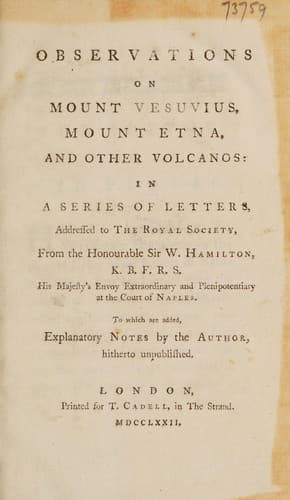
Observations on Mount Vesuvius, Mount Etna, and Other VolcanosHamilton, William, Sir
Science
Observations on Mount Vesuvius, Mount Etna, and Other Volcanos
Hamilton, William, Sir
Etna, Mount (Italy) -- Early works to 1800; Vesuvius (Italy) -- Early works to 1800; Volcanoes -- Italy -- Early works to 1800
The favourable reception, which my account of last year's eruption of
Mount Vesuvius met with from your Lordship; the approbation which the
Royal Society was pleased to shew, by having ordered the same to be
printed in their Philosophical Transactions; and your Lordship's
commands, in your letter of the 3d instant; encourage me to trouble you
with a plain narrative of what came immediately under my observation,
during the late violent eruption, which began October 19, 1767, and is
reckoned to be the twenty-seventh since that, which, in the time of
Titus, destroyed Herculaneum and Pompeii.
The eruption of 1766 continued in some degree till the 10th of December,
about nine months in all[6]; yet in that space of time the mountain did
not cast up a third of the quantity of lava, which it disgorged in only
seven days, the term of this last eruption. On the 15th of December,
last year, within the ancient crater of Mount Vesuvius, and about twenty
feet deep, there was a crust, which formed a plain, not unlike the
Solfa terra in miniature; in the midst of this plain was a little
mountain, whose top did not rise so high as the rim of the ancient
crater. I went into this plain, and up the little mountain, which was
perforated, and served as the principal chimney to the Volcano: when I
threw down large stones, I could hear that they met with many
obstructions in their way, and could count a hundred moderately before
they reached the bottom.
Vesuvius was quiet till March 1767, when it began to throw up stones
from time to time; in April, the throws were more frequent, and at night
fire was visible on top of the mountain, or, more properly speaking, the
smoak, which hung over the crater, was tinged by the reflection of the
fire within the Volcano. These repeated throws of cinders, ashes, and
pumice stones, increased the little mountain so much, that in May the
top was visible above the rim of the ancient crater. The 7th of August,
there issued a small stream of lava, from a breach in the side of this
little mountain, which gradually filled the valley between it and the
ancient crater; so that, the 12th of September, the lava overflowed the
ancient crater, and took its course down the sides of the great
mountain; by this time, the throws were much more frequent, and the red
hot stones went so high as to take up ten seconds in their fall. Padre
Torre, a great observer of Mount Vesuvius, says they went up above a
thousand feet.
The 15th of October, the height of the little mountain (formed in about
eight months) was measured by Don Andrea Pigonati, a very ingenious
young man, in his Sicilian Majesty's service, who assured me that its
height was 185 French feet.
Public-domain text, read in full here on John Shaqi.
Reviews
Reviews
No reviews yet
Be the first to share your thoughts on this work.
Join the Discussion
Join the discussion
Sign in to leave a comment or review.
Sign InorCreate an account