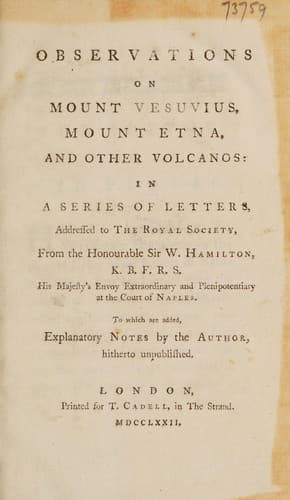
Observations on Mount Vesuvius, Mount Etna, and Other VolcanosHamilton, William, Sir
Science
Observations on Mount Vesuvius, Mount Etna, and Other Volcanos
Hamilton, William, Sir
Etna, Mount (Italy) -- Early works to 1800; Vesuvius (Italy) -- Early works to 1800; Volcanoes -- Italy -- Early works to 1800
From my villa, situated between Herculaneum and Pompeii, near the
convent of the Calmaldolese (marked 7 in Plate I.) I had watched the
growing of this little mountain; and, by taking drawings of it from
time to time, I could perceive its increase most minutely. I make no
doubt but that the whole of Mount Vesuvius has been formed in the same
manner; and as these observations seem to me to account for the various
irregular strata, which are met with in the neighbourhood of Volcanos, I
have ventured to inclose, for your Lordship's inspection, a copy of the
abovementioned drawings. (Plate III.)
The lava continued to run over the ancient crater in small streams,
sometimes on one side, and sometimes on another, till the 18th of
October, when I took particular notice that there was not the least lava
to be seen; owing, I imagine, to its being employed in forcing its way
towards the place where it burst out the following day. As I had,
contrary to the opinion of most people here, foretold the approaching
eruption[7], and had observed a great fermentation in the mountain
after the heavy rains which fell the 13th and 14th of October; I was not
surprized, on the 19th following, at seven of the clock in the morning,
to perceive from my villa every symptom of the eruption being just at
hand. From the top of the little mountain issued a thick black smoak, so
thick that it seemed to have difficulty in forcing its way out; cloud
after cloud mounted with a hasty spiral motion, and every minute a
volley of great stones were shot up to an immense height in the midst of
these clouds; by degrees, the smoak took the exact shape of a huge
pine-tree, such as Pliny the younger described in his letter to Tacitus,
where he gives an account of the fatal eruption in which his uncle
perished[8]. This column of black smoak, after having mounted an
extraordinary height, bent with the wind towards Caprea, and actually
reached over that island, which is not less than twenty-eight miles from
Vesuvius.
Public-domain text, read in full here on John Shaqi.
Reviews
Reviews
No reviews yet
Be the first to share your thoughts on this work.
Join the Discussion
Join the discussion
Sign in to leave a comment or review.
Sign InorCreate an account