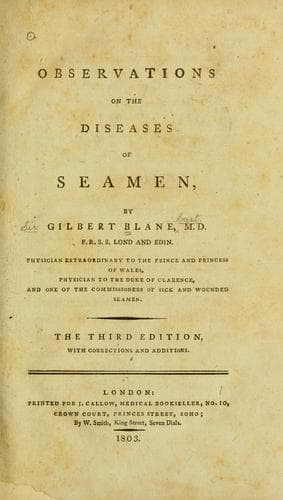
Observations on the Diseases of SeamenBlane, Gilbert, Sir
History
Observations on the Diseases of Seamen
Blane, Gilbert, Sir
Medicine, Naval -- Early Works To 1800; Sailors -- Diseases
The men that were brought from the ships to the hospitals were affected
with the disease in various stages; but as we had in general a very
inaccurate history of the several cases, the method of treatment
upon their first admission was pretty nearly the same in all; and it
consisted, in the first place, in washing their face, hands, feet, and
legs, with warm water and vinegar, from which they derived the greatest
comfort, being commonly very dirty. There ought to be a [96]warm bath
at every naval hospital kept in constant readiness; for there are so
few conveniences on board of a ship for preserving bodily cleanliness
among the sick, that the surface of the body becomes loaded with
filth, so that the operation of the warm bath could not fail to be
highly comfortable and salutary as the first step to their cure when
brought on shore. We had generally very indistinct information about
the state of their bowels, as well as other circumstances, on account
of their delirium; but it was at any rate useful, or at least safe,
to give them a clyster. They were enjoined plentiful dilution; and if
they were low, some wine and water was allowed. In the evening, the
anodyne diaphoretic medicine was administered, and a blister applied
to some part of the body. In consequence of this method, we seldom
failed to find the patients better next morning; and it was tried in
such numbers, that the efficacy of it was sufficiently ascertained. It
happened in some cases, that these means were omitted, and a comparison
of these with the others served to ascertain the true efficacy of the
medicines; the stationary state of the symptoms, when the disease
was thus left to itself, sufficiently proving the propriety of the
treatment above described.
It is an important question to what circumstances of this fever the
Peruvian bark is adapted. An early and indiscriminate use of it is
recommended in some late publications, upon the authority of which
I tried it without regard to the stages or symptoms, and without
any prejudice either for or against the practice; but I found that
this powerful remedy was in danger of doing much harm, unless great
attention was paid to circumstances, in order to ascertain the proper
seasons for giving it. The symptoms that forbid the use of bark are
chiefly foul bowels, hard pulse, sizy blood, great delirium, dry
tongue, a hot and dry skin, and inflammatory affections of the viscera.
It was found extremely pernicious in an early stage of the disease
previous to evacuations; and the object of practice at this time should
be to relieve the habit by means of these, in order to produce a
general relaxation of the secretions, and to render the skin cool and
soft, thereby paving the way for the bark.
Public-domain text, read in full here on John Shaqi.
Reviews
Reviews
No reviews yet
Be the first to share your thoughts on this work.
Elsewhere in the archive
Join the Discussion
Join the discussion
Sign in to leave a comment or review.
Sign InorCreate an account