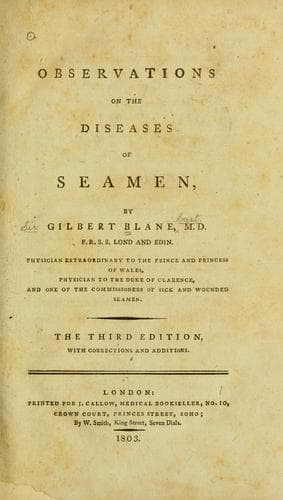
Observations on the Diseases of SeamenBlane, Gilbert, Sir
History
Observations on the Diseases of Seamen
Blane, Gilbert, Sir
Medicine, Naval -- Early Works To 1800; Sailors -- Diseases
The next remedy mentioned was opium. It is a medicine more admissible
and useful in this than any other kind of fever. The same cautions
nearly apply in the administration of it as have been given with
regard to the Peruvian bark. The caution with regard to foul bowels is
particularly necessary in a hot climate, where an over secretion of
bile is so apt to take place. When, the Boreas frigate arrived from
England in March, 1783, there was a very bad fever of the infectious
kind on board, some cases of which being sent to the hospital at St.
Lucia, were treated unsuccessfully with bark and opium, which I had
been induced to try upon the authority of the authors above alluded
to. I attributed this want of success to the neglect of previous
evacuation; for, upon inspecting the bodies, the intestines were found
full of bilious _feces_. I profited from this, and was more successful
in the other cases. It were to be wished that physicians could oftener
bring themselves to confess their errors in practice, and their
writings would be more instructive; for it is of consequence to know
what we are to avoid as well as what we are to follow.
It has been mentioned that the best effects arise from the conjunction
of an antimonial with an opiate; but, in this sort of fever,
antimonials, and even most of the neutral salts, are hurtful after the
first stage, and opiates may after this be given alone or combined with
camphor. With regard to the precise period of leaving off antimonials,
it must be left to discretion, and the constitution of the patient is
the best guide. There is so great a difference in patients in this
respect, that all practical precepts should be qualified by a due
discrimination of constitutions. Absolute and dogmatical rules are so
far from applying in the practice of physic, that there are some cases
of the same disease that require a treatment even opposite to what
is in general most adviseable. This may be very aptly illustrated by
the small pox, of which there are cases that ought to be treated very
differently from the general method laid down by Sydenham, and in which
cordial medicines are highly proper and necessary. This difference
in diseases themselves seems to be one great cause of the difference
of opinion among physicians on practical points, each party finding
some countenance in experience for their general doctrine, do not
make allowance for the varieties that exist in nature; so that, in one
sense, both may be said to be in the right. If the patient is not very
much sunk, and if there are bilious symptoms, or an obstinate dryness
in the skin, a few grains of James’s powder may be given with advantage
even in an advanced period of the disease. If a hot and dry skin should
at this period be the only troublesome symptom, it will be more safely
and effectually removed by camphor combined with something opiate and
the _Spiritus Mindereri_, which is the only neutral now admissible,
Public-domain text, read in full here on John Shaqi.
Reviews
Reviews
No reviews yet
Be the first to share your thoughts on this work.
Elsewhere in the archive
Join the Discussion
Join the discussion
Sign in to leave a comment or review.
Sign InorCreate an account