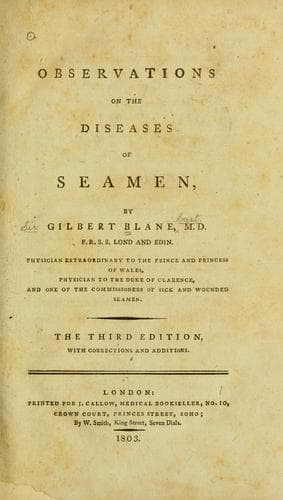
Observations on the Diseases of SeamenBlane, Gilbert, Sir
History
Observations on the Diseases of Seamen
Blane, Gilbert, Sir
Medicine, Naval -- Early Works To 1800; Sailors -- Diseases
than by antimonials, which, at this time, would be in danger either of
ruffling the patient by their operation on his stomach and bowels, or
of weakening him too much either in this way, or by exciting profuse
sweats. Evacuant medicines of every kind being then improper, clysters
are the only laxatives to be employed in case the state of the bowels
require them.
Having mentioned camphor, it may be proper here to remark, that it is
a medicine of which I have found it extremely difficult to ascertain
the virtues and effects; and in consequence of this ambiguity, I
believe there are few articles of the materia medica more abused in
practice. In all inflammatory affections, and in the beginning of all
fevers where there is much heat and thirst, I think I have observed it
to aggravate the symptoms. It seems in no case to be more proper than
at certain periods of this fever, and especially when there happens
to be spasmodic pains of the stomach, or tremors and cramps in the
extremities.
In this advanced stage of the fever, in which the most common symptoms
are weakness, restlessness, tremors, and low delirium, no medicine
was found so much to be trusted to as opium, which here acts as a
cordial as well as an anodyne and antispasmodic. It may be given, in
the camphorated julep, in the form of tincture, from five to ten drops
every six or eight hours, or some of the officinal compounds, such as
the theriaca or mithridate, may be employed with advantage. I have
thought also, that, at this period, castor conjoined with opium seemed
to improve its virtue. This was first suggested to me by Mr. Crudie,
an ingenious German surgeon, whom I employed as an assistant at the
hospital at St. Lucia; and since I have been physician to St. Thomas’s
hospital, I have found the most pleasing effects, in similar cases,
from a composition used there, the principal ingredients of which are
opium and castor[97].
In this state of the fever I have also used with advantage the
decoction of Peruvian bark and serpentary, as recommended by Sir John
Pringle; and when the skin is cold and the circulation is very languid,
as is sometimes the case, volatile salts and powder of serpentary may
very properly be employed.
But in the advanced state, and in the worst forms of this disease,
there is perhaps no medicine superior to wine. This was given either
pure, or diluted with water for common drink, and sometimes to the
quantity of a quart in twenty-four hours. In delicate people, such as
we meet with in private practice, the quantity ought to be less.
There is this caution necessary with regard to the use of wine, that
when the fever is gone off, and only extreme debility remains, the free
use of it is not safe nor proper; for, in a weak and exhausted state,
a person is more apt to be [98]heated and intoxicated by any fermented
liquor, than in health, or even in the preternatural and disturbed
state of actual disease, such as occurs in this fever.
Public-domain text, read in full here on John Shaqi.
Reviews
Reviews
No reviews yet
Be the first to share your thoughts on this work.
Elsewhere in the archive
Join the Discussion
Join the discussion
Sign in to leave a comment or review.
Sign InorCreate an account