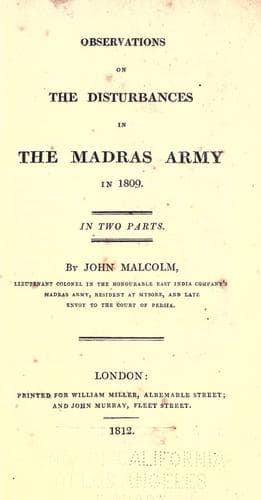
Observations on the Disturbances in the Madras Army in 1809Malcolm, John
History
Observations on the Disturbances in the Madras Army in 1809
Malcolm, John
India. Army -- History; Malcolm, John, 1769-1833
The merits of this unhappy act of power have been fully investigated in
England; and the general opinion seems decidedly against the Government
of Fort St. George. The wisdom and expediency of the act is defended
by none; and some of the first law authorities[5] in England doubt its
justice. The subject has been completely exhausted; and I shall say no
more upon it, than that there, perhaps, never was so complete a want
of knowledge displayed of the character of military feeling, as in the
attempt made to prevail upon Major Boles to degrade himself in his own
profession, by making an apology for having performed what he deemed
his duty, and what he could not have expressed regret for having done,
without an admission of guilt. The urgency with which this apology was
sought, is of itself a proof that the Government had been precipitate.
How much more manly, wise, and dignified, would it have been to have
rescinded the resolution which had been taken, on the plain ground
of a conviction that Major Boles had erred from want of knowledge,
and without intention of offence; and such must have been the actual
sentiments which were entertained of his conduct, or Government could
never have professed itself ready to accept a slight apology. But
a little stickling spirit about supposed dignity, more worthy of a
wrong-headed individual engaged in an affair of honour, than a great
Government, prevented this obvious measure, and produced irremediable
mischief to the state.
On the 1st of February, the day subsequent to that on which Major Boles
was suspended, an order was issued, suspending the Adjutant-General,
Lieutenant-Colonel Capper, for the same offence, that of being
concerned in circulating the offensive order of the Commander-in-Chief.
The only difference in the facts of this case from that of Major Boles,
(they were alike in principle), was, that Colonel Capper, the moment
he heard of Major Boles's suspension, made a declaration, that the
circumstance of his being with General McDowall was the sole cause that
had led to Major Boles's name being affixed to orders which it was
his (the Adjutant-General's) duty to sign; and that he considered all
responsibility connected with the office of Adjutant-General rested
solely with him, as principal. The generous object of this gallant and
meritorious officer (who was lost on his passage to England), was to
exculpate his deputy. He did not, however, succeed in that object; and
his free avowal of the principal share he had in the circulation of
the order was instantly taken as the ground for inflicting a similar
punishment on him.
Public-domain text, read in full here on John Shaqi.
Reviews
Reviews
No reviews yet
Be the first to share your thoughts on this work.
Join the Discussion
Join the discussion
Sign in to leave a comment or review.
Sign InorCreate an account