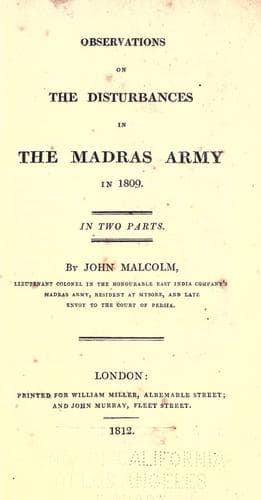
Observations on the Disturbances in the Madras Army in 1809Malcolm, John
History
Observations on the Disturbances in the Madras Army in 1809
Malcolm, John
India. Army -- History; Malcolm, John, 1769-1833
From the hour that these measures were adopted, the state of the army
underwent a complete revolution. The most discontented had, till this
period, been cautious in their measures, and aimed at no more than
obtaining some attention to what they deemed their grievances. There
is no doubt, that before these orders were issued a very general
spirit of dissatisfaction prevailed; but there was no danger of that
taking any mutinous or rebellious shape. Many, and among these some of
the most respectable officers in the army, had up to this date taken
no concern in those proceedings that had offended Government: but the
suspension of Colonel Capper and Major Boles (particularly the latter,
who, it was perfectly known, had no share in the councils of the
Commander-in-Chief, and whose act of signing and issuing the obnoxious
order was therefore exclusively ministerial,) effected a complete and
dangerous change in the general temper. All seemed to be actuated
by the same resentment at measures which they deemed arbitrary and
unjust; and many officers of the highest rank and first respectability,
both in his Majesty's and the Honourable Company's service, joined in
reprobating the principle upon which it was adopted. The subsequent
efforts made to prevail upon Major Boles to sign an apology, and the
letter circulated by the commanding officer of the forces, General
Gowdie, which condemned that officer for not having acceded to this
proposition, had the double effect of increasing the indignation at
Government and the popularity of Major Boles, who was, after this
act, deemed an honourable martyr in a cause which it was the duty of
every military officer to support. Before the more moderate, and with
them all those officers of his Majesty's service who had given way to
their first feelings, had recovered from their error, numbers of the
more violent in the Company's service were irretrievably pledged to
violent and guilty proceedings, into which there is no doubt they were
deluded by the force of example, and the assurance that the cause in
which they were engaged was general. The first of their acts which
attracted the notice of Government, was the agitation and preparation
of an address to the Governor General, remonstrating against the acts
of the Government of Fort St. George, and soliciting the removal
of Sir George Barlow; and an address, or letter, to Major Boles,
conveying to that officer a contribution for his support during what
the addressers deemed his unjust suspension. The Government, in an
order dated the 1st of May, 1809, suspended Captain J. Marshall and
Lieutenant-Colonel Martin, on the ground of their being principally
concerned in preparing the Memorial[6] (or, as it is termed in this
order, "seditious paper,") addressed to the Governor General; and the
same punishment was inflicted upon Lieutenant-Colonel the Honourable
Arthur St. Leger, on the ground of his having promoted the circulation
Public-domain text, read in full here on John Shaqi.
Reviews
Reviews
No reviews yet
Be the first to share your thoughts on this work.
Join the Discussion
Join the discussion
Sign in to leave a comment or review.
Sign InorCreate an account