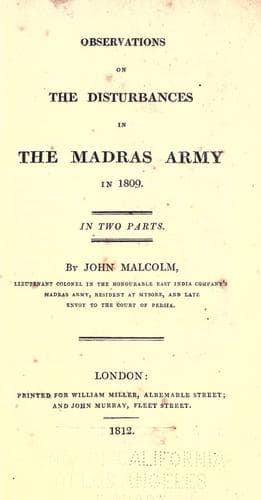
Observations on the Disturbances in the Madras Army in 1809 — John Shaqi
Observations on the Disturbances in the Madras Army in 1809Malcolm, John
History
Observations on the Disturbances in the Madras Army in 1809
Malcolm, John
India. Army -- History; Malcolm, John, 1769-1833
Government had, no doubt, a right to expect success in the execution
of this measure; it had a just reliance on the fidelity and attachment
of his Majesty's troops. A few regiments, who composed part of the
British army, could not have joined in such a confederacy without
incurring certain and indelible disgrace: and it had been the policy
of the Government of Fort St. George, from the first appearance of
dissatisfaction and discontent, to court the allegiance and flatter
the feelings of this branch of the service. And though no man can
calculate the temper that was lost, or the consequent evils that have
been produced by this proceeding, the limited object was undoubtedly
attained.
Sir George Barlow appears to have had great confidence in the
attachment of the native troops to Government; which, I believe, he
always thought was paramount to their attachment to their European
officers: and this was consequently calculated upon as one great means
of carrying his measures into prompt and successful execution: but
certainly the fulfilment of this hope depended upon the course pursued
by the European officers who commanded these men. There could be no
ground to make such a conclusion upon any general principles applicable
to military bodies, and much less so from the constitution, character,
or history of the native branch of the military establishment in
India. The difficulty that a body of officers have in any service,
is to keep soldiers to their duty: there is little in debauching
them from it. They are led by example: and to follow that of their
officers, is both a principle and a habit. The native troops of India
are perhaps more attached to their European officers than any others.
These officers are to them the only representatives they know of the
Government they serve; they are the sole link in the chain of their
attachment; and, with rare exceptions, their men are completely
devoted to them. The Governor might, perhaps, expect, that though this
feeling would operate in the first instance, it would soon give way
to a fear of losing all those solid benefits that the service of the
Company offers; and that the sepoys would never continue to attach
their fortunes to so desperate a cause as that of the officers must
soon appear. This is a natural conduct for a sensible and reflecting
man: but do soldiers think, or reflect deeply? Would not the increased
pay which their officers (if they were serious in rebellion) would be
likely to give, or, what is still more attractive to men like them,
a latitude to plunder, have more effect than twenty proclamations
to recall them to their duty. Besides, had this dreadful contest
continued, the passions would have had their way, and a few months
might have changed the character of our native soldiery, and rendered
them more formidable than all the enemies we ever had to encounter in
India.
Public-domain text, read in full here on John Shaqi.
Reviews
Reviews
No reviews yet
Be the first to share your thoughts on this work.
Join the Discussion
Join the discussion
Sign in to leave a comment or review.
Sign InorCreate an account