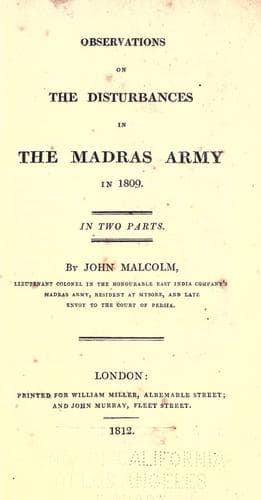
Observations on the Disturbances in the Madras Army in 1809 — John Shaqi
Observations on the Disturbances in the Madras Army in 1809Malcolm, John
History
Observations on the Disturbances in the Madras Army in 1809
Malcolm, John
India. Army -- History; Malcolm, John, 1769-1833
It will at least appear, from what has been said on the subject, that
Government had no right to look to the fidelity and attachment of the
native troops, as a certain means of coercing their European officers
to obedience. But the fact was, that the sure ground of success, and
that on which the Government had more right to calculate (when it
resorted to extremes,) than all others put together, was the action of
the virtuous feelings and loyal principles of the Company's officers
themselves, and the total want of object, accord and combination, in
the execution of the indigested plans of the most violent. It was
well known that many of those officers had never brought their minds
to contemplate disobedience to the state: and the most guilty even, at
first proceeded on the idea that such an extreme would never occur.
They certainly had hoped that Government would yield, to avoid it: and
when they latterly found that result was not likely, they shuddered
at the crisis which they had precipitated. They had no object in view
that could justify to their own minds the extremes in which they were
involved; they found themselves on the point of being placed in the
situation of rebels, with minds altogether unsuited to act that part
which can alone give a hope of success to the cause of rebellion. They
could not (violent as they were against the Governor of Madras and some
others) bring their minds to believe they were enemies to a revered
King and beloved country; and they consequently wished to reconcile the
incompatible principles of opposition to the local Government, with a
spirit of fidelity to their employers, and loyalty to their sovereign.
There could be no doubt of their sincerity in these feelings: and,
from the clashing of such opposite principles of action, Government
had a right to expect irresolution, division, and distraction in their
councils and measures. It was certain that many would not join in any
act of disobedience, and that those who ventured on opposition would
proceed with alarm; and every moment of reflection would make them
view with increased horror the guilt in which they were involved, and
produce a wavering and hesitation that must soon have the effect of
losing them the confidence of their followers and of each other.
Public-domain text, read in full here on John Shaqi.
Reviews
Reviews
No reviews yet
Be the first to share your thoughts on this work.
Join the Discussion
Join the discussion
Sign in to leave a comment or review.
Sign InorCreate an account