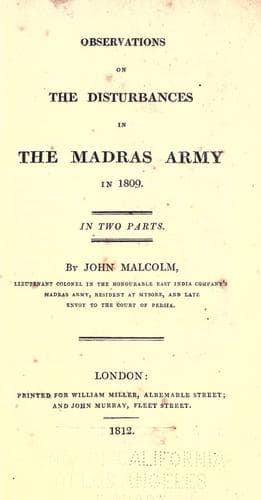
Observations on the Disturbances in the Madras Army in 1809 — John Shaqi
Observations on the Disturbances in the Madras Army in 1809Malcolm, John
History
Observations on the Disturbances in the Madras Army in 1809
Malcolm, John
India. Army -- History; Malcolm, John, 1769-1833
Some agitation, though of a trifling nature, had prevailed among the
Company's officers on the coast establishment from a period as far back
as the publication of the Regulations of the year 1796, which they
conceived to entitle them to a complete equalization of allowances with
the officers of the Bengal establishment. These feelings had little
time for operation in the course of that active and brilliant service
in which the Madras army was employed during the administration of Lord
Wellesley. The increase of establishment rendered necessary to preserve
the great accession of territory acquired by that nobleman, occasioned
a promotion, that, for a period, silenced their discontent; but that
spirit was revived in the year 1805 and 1806, when, in addition to
their former grievance, they conceived that there was an evident and
injurious partiality shown towards his Majesty's officers, who were
said to be promoted to commands and staff situations to the injury
of the officers of the Company's service. Addresses to Government
and to the Court of Directors were at this period agitated and in
circulation; but none, to my knowledge, were brought forward; owing,
perhaps, to the orders from the Honourable the Court of Directors,
who, it would appear, had, on private representation, adopted some
measures to redress those grievances of which the army at that moment
complained. This spirit of discontent might have died of itself; or, at
all events, it would have been more easily repressed, had not the flame
of discord burst out in a higher quarter. The quarrel which occurred
between the Governor, Sir George Barlow, and the Commander-in-Chief,
General McDowall, may, no doubt, (as it led to those measures which
Government adopted towards the general staff of the coast army,) be
deemed the remote source of all the violent and indefensible acts
of the army, and in that view merits a short notice. The mind of
General McDowall was much irritated at his not being appointed to
council; and he gave way, in consequence, to a language of complaint
and discontent, of which, it must be concluded, he could never have
calculated the effect. Every act of Government that affected the wishes
or interests of either an individual or a class of officers naturally
caused complaints, which the Commander-in-Chief certainly did not
discourage. He must have thought that the influence and importance of
a seat in council would have enabled him more easily to have satisfied
or silenced their murmurs; and he cannot be supposed to have felt much
sorrow that Government should have experienced the inconvenience of an
exclusion which he considered as so great a personal grievance: and
when his mind was further irritated by what he deemed to be slight
and neglect, on the part of Sir George Barlow, of his rights in his
military character of Commander-in-Chief, these feelings had probably
a wider action. In the temper which I have shown the coast army was in
Public-domain text, read in full here on John Shaqi.
Reviews
Reviews
No reviews yet
Be the first to share your thoughts on this work.
Join the Discussion
Join the discussion
Sign in to leave a comment or review.
Sign InorCreate an account