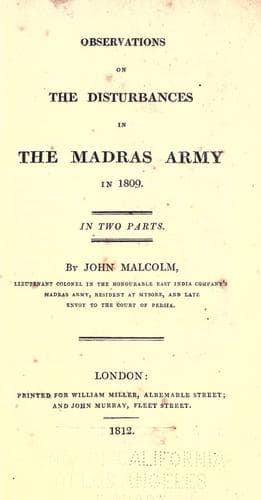
Observations on the Disturbances in the Madras Army in 1809 — John Shaqi
Observations on the Disturbances in the Madras Army in 1809Malcolm, John
History
Observations on the Disturbances in the Madras Army in 1809
Malcolm, John
India. Army -- History; Malcolm, John, 1769-1833
at this moment, it is not surprising, when they saw such an example
of discontent, and felt unrepressed by that high authority which was
immediately over them, that they should have been more bold, and that
their violence should have taken a more formidable shape towards
Government, against which this spirit was, by the proceeding of the
Commander-in-Chief, very unadvisedly and inconsiderately, however
unintentionally, directed. But if a want of reflection on one part (few
will accuse General McDowall of more than want of reflection) led to
such consequences, can we say there was much more wisdom on the other,
which, if it did not provoke, never made one attempt to prevent, the
occurrence of those evils with which it was threatened? A cold, even,
mechanic course of action, which gave great attention to the ordinary
rules of public business dignified with the name of public principles,
but none to human nature, was opposed at this period to the proceedings
of the Commander-in-Chief and the army; and had the effect, which was
to be expected, of accelerating that crisis which it was so important
to avoid.
It may be here necessary to explain what was meant by the term public
principle. It was constantly used at Madras (with some deviation, I
conceive, from its highest and most dignified sense) to denote the
rules of public business founded either in precedent or in written law,
and certainly well adapted for order and convenience in the common
course of affairs. But if such rules were sufficient, no talents
would be necessary to govern mankind. A copying clerk, or even the
regulation-book which he copies, might rule a state. Success in this
endeavour (the object of which is to render the task of Government
simple and easy) will be always agreeable to the character of the
Government. The more despotic that is, the more easily may we preserve
inviolate such rules or principles. For though great commotions will
occur in the most despotic states, and force their rulers to an
occasional deviation from such principles, these deviations will be
unfrequent to what must arise in more free and liberal governments,
in which that constant attention which it is necessary to pay to
men's tempers, and to those pretensions and rights upon which such
an order of things is grounded, must produce a much more frequent
departure from the exact letter (and sometimes from the spirit) of
those unbending rules. It is this fact which renders the task of
government so much more difficult in those states than in any others.
Any man (who has obsequious slaves to govern) can, if he has memory to
recollect the principles of rule, be a despot, or a despot's deputy;
but far different qualities are required where the minds of those under
authority are of a freer and bolder stamp: over such a society those
alone are fit to rule, who, fully informed of all its component parts,
can judge the periods when the temporary departure from an established
Public-domain text, read in full here on John Shaqi.
Reviews
Reviews
No reviews yet
Be the first to share your thoughts on this work.
Join the Discussion
Join the discussion
Sign in to leave a comment or review.
Sign InorCreate an account