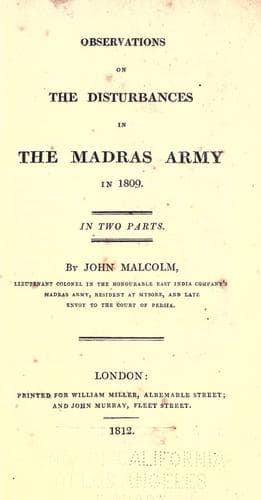
Observations on the Disturbances in the Madras Army in 1809Malcolm, John
History
Observations on the Disturbances in the Madras Army in 1809
Malcolm, John
India. Army -- History; Malcolm, John, 1769-1833
It is a remarkable fact, that the officers who had signed the charges
against Colonel Munro, were, on reflection, and from learning the
sentiments of the Judge-Advocate-General, so convinced that the
charges they had made were either groundless or illegal, that they
wrote to the Commander-in-Chief to suspend the prosecution of them.
This certainly proves (if any proof was wanting) that there could
have been no doubt of the result of a court martial, grounded on the
state of general feelings, as far as that regarded the charges against
Lieutenant-Colonel Munro; for if the accusers themselves had shown
they distrusted the cause they had so rashly adopted, there could,
assuredly, be no apprehension of the judgment of thirteen officers of
rank (all of whom, if it had been thought necessary, might have been
chosen from his Majesty's service) giving a biassed or unjust sentence.
The Government of Madras, in their dispatch to the Court of Directors
upon this subject, draw a directly opposite conclusion from this fact,
which, they say, "proves in itself the inexpediency of their having
had recourse to such a proceeding;" but they state no grounds for this
conclusion. In the whole course of this affair they appear to have
been much, if not solely, guided by the opinion of their law officers:
and no man can peruse the letter of Lieutenant-Colonel Leith upon this
subject, without a just respect for the talents and extensive legal
knowledge of that public officer. But those that think great, numerous,
and obvious evils resulted from the decision of Government on the
case of Lieutenant-Colonel Munro, will not immediately perceive the
necessity of its having been governed by rules of law in its decision
on a question which clearly involved the most serious considerations
of state policy. They will think, and with justice, this was a
question not for lawyers, but statesmen; who, in the exercise of their
legitimate discretion, are in the situation in which Mr. Burke has so
well described legislators; and therefore, like them, "ought to do
what lawyers cannot, for they have no rules to bind them but the great
principles of reason and equity and the general sense of mankind;
these they are bound to obey and follow: and rather to enlarge and
enlighten law by the liberality of legislative reason, than to fetter
and bind their high capacity by the narrow constructions of subordinate
artificial justice."
Public-domain text, read in full here on John Shaqi.
Reviews
Reviews
No reviews yet
Be the first to share your thoughts on this work.
Join the Discussion
Join the discussion
Sign in to leave a comment or review.
Sign InorCreate an account