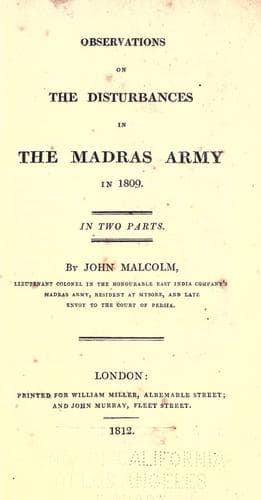
Observations on the Disturbances in the Madras Army in 1809 — John Shaqi
Observations on the Disturbances in the Madras Army in 1809Malcolm, John
History
Observations on the Disturbances in the Madras Army in 1809
Malcolm, John
India. Army -- History; Malcolm, John, 1769-1833
It will be unnecessary to trace the petty differences which took
place between the Commander-in-Chief and the Governor: the general
character and evil effect of these differences have been described.
The first act which led to serious discussions, was the former
placing the Quarter-Master-General, Lieutenant-Colonel Munro, in
arrest. The nature of this case is well known: and few, I imagine,
can doubt that Government had _a right_ to command his release: but
it will remain a question with many, how far a knowledge of the
character and actual temper of the Commander-in-Chief, the state of
the army, and other circumstances, would have warranted Government
in forbearing to use _this right_. It is nonsense to say, that it
would, by so forbearing and moderate a proceeding, have abandoned
an officer entitled to protection. This language, if it means any
thing, implies that Government did not conceive there were at that
moment thirteen officers, either in the King's or Company's service,
on the coast, upon whose honesty and honour it could rely. This is a
proposition which appears too extravagant for notice: but, even if this
point be conceded, will it be said, if Colonel Munro had suffered an
additional injustice by the sentence of a violent and partial court
martial, that the Government was, in that extreme case, deprived of
the right to protect that officer? On the contrary, would not the
necessity for the exercise of that right have been, under such an
event, much more apparent and unobjectionable. It may be asked, if any
circumstances could justify Government in so pusillanimous a conduct,
as that of forbearing to exercise an admitted right, and of allowing
a court martial to judge upon a public act which it had recognised
and approved? It is to be replied, that such conduct might, on many
occasions, be the result of prudence and of fortitude. It is weakness,
not firmness, that takes an early alarm at danger, and by showing a
want of confidence in all the subordinate aids of its power, creates,
by its suspicion, that defection which it apprehends. In the recent
case of Sir Francis Burdett, the House of Commons did not abandon its
exclusive right, but it forbore the exercise of that right, and, with a
confidence and wisdom worthy of so enlightened and august an assembly,
allowed a question, which involved its rights and authority, to be
discussed in a court of law. There can, I should conceive, be no doubt
whatever, that had Colonel Munro been tried on the charges preferred
against him, he would have been honourably acquitted; and the influence
and reputation of his accusers would have been in no slight degree
lessened: an object which, in itself, was of consequence at that period
to Government.
Public-domain text, read in full here on John Shaqi.
Reviews
Reviews
No reviews yet
Be the first to share your thoughts on this work.
Join the Discussion
Join the discussion
Sign in to leave a comment or review.
Sign InorCreate an account