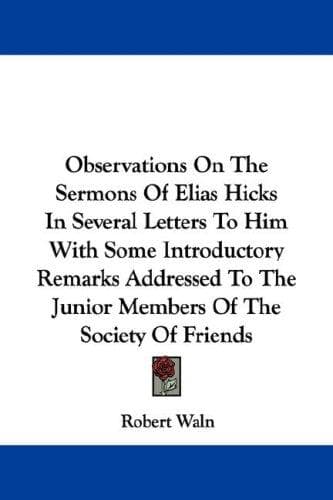
Observations on the Sermons of Elias Hicks: In Several Letters to Him; With Some Introductory Remarks, Addressed to the Junior Members of the Society of Friends.Waln, Robert
Religion
Observations on the Sermons of Elias Hicks: In Several Letters to Him; With Some Introductory Remarks, Addressed to the Junior Members of the Society of Friends.
Waln, Robert
Hicks, Elias, 1748-1830; Society of Friends -- Hicksite controversy
"I am far (says Locke,) from denying that God can, or doth sometimes,
enlighten men's minds in the apprehending of certain truths, or excite
them to good actions, by the immediate influence and assistance of the
Holy Spirit, without any extraordinary signs accompanying it. But in
such cases we have reason and Scripture, unerring rules, to know whether
it be from God or no. Where the truth embraced is consonant to the
revelation in the written word of God, or the action conformable to the
dictates of right reason, or Holy Writ, we may be assured that we run no
risk in entertaining it as such; because, though it be not an immediate
revelation from God, extraordinarily operating on our minds, yet we are
sure it is warranted by that revelation which he has given us of truth.
But it is not the strength of our private persuasion within ourselves,
that can warrant it to be a light or motion from Heaven; nothing can do
that but the written word of God without us, or that standard of reason
which is common to us with all men. Where reason or Scripture is express
for any opinion or action, we may receive it as of divine authority; but
it is not the strength of our own persuasions which can by itself give
it that stamp. The bent of our own minds may favour it as much as we
please; that may show it a fondling of our own, but will by no means
prove it to be an offspring of Heaven, and of divine original."
Here is a great coincidence between the opinions of the christian
philosopher and the quaker apologist; and although they refer to right
reason as well as the Scriptures, as our guide, they meant not to use
them in contradistinction to each other. When we refer to either of two
rules to solve a proposition, it is because both will produce the same
result; and they introduced the word reason, as applicable only to those
opinions and actions, respecting which, the Scriptures are silent.
If, says the philosopher, the doctrine is consonant to reason or
Scripture, it may be received without risk, although it may not proceed
from an immediate revelation of God. Divine revelation, says the
apologist, can never contradict the outward testimony of the Scriptures
or right reason; and whatever any do, pretending to the spirit, which is
contrary to the Scriptures, must be accounted and reckoned a delusion of
the devil.
By this test no genuine quaker can object to being tried,[4] "for he
preaches no new gospel, but that which is confirmed by all the miracles
of Christ and his apostles; and he offers nothing but that which he is
able and ready to confirm by the authority of the Scriptures, which all
protestants acknowledge to be true." It is indeed the only criterion by
which we can judge of the faith of man, and by that criterion, how few
of your sermons would escape condemnation.
Footnote 4:
Barclay.
LETTER II.
Public-domain text, read in full here on John Shaqi.
Reviews
Reviews
No reviews yet
Be the first to share your thoughts on this work.
Join the Discussion
Join the discussion
Sign in to leave a comment or review.
Sign InorCreate an account