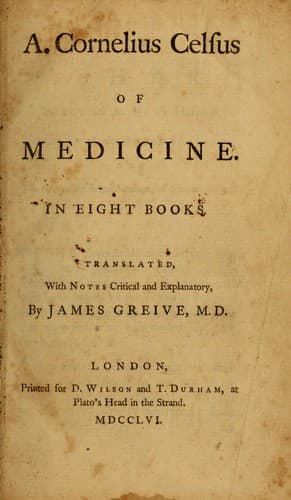
Of Medicine, in Eight BooksCelsus, Aulus Cornelius
History
Of Medicine, in Eight Books
Celsus, Aulus Cornelius
Medicine, Greek and Roman
But patients are more easily managed with regard to food; because
in spite of some inclination of their own, the stomach then refuses
it. But in the article of drink the struggle is hard; and the more
violent, the higher the fever is: for this inflames the thirst, and
demands water most importunately, when it is most dangerous. But the
patient is to be informed, that when the fever has abated, the thirst
also will immediately decline; and that the paroxysm will be longer,
if any nourishment be given to him: and that he that drinks none, is
sooner freed from the thirst. However as even people in health can
bear hunger a good deal easier than thirst, it is necessary to indulge
the sick more with regard to drink than food. But on the first day no
moisture ought to be given, unless the pulse has suddenly sunk so low,
that there is a necessity for giving food also; but on the second and
following days likewise, where food is not to be allowed, yet if the
thirst be violent, drink may be given.
What was said by Heraclides of Tarentum is not altogether without
reason; that when either bile or crudity make a patient uneasy; it is
expedient by a moderate quantity of a drink to mix new matter with the
corrupted. This rule ought carefully to be observed, that the same
times be chosen for drink as for food: when it is to be given without
the other, let it be at a time, when we would desire the patient
to sleep, which commonly thirst prevents. It is generally allowed,
that as too much moisture is hurtful to every person in a fever, it
is especially so to such women, as have fallen into fevers after
child-bearing.
Public-domain text, read in full here on John Shaqi.
Reviews
Reviews
No reviews yet
Be the first to share your thoughts on this work.
Elsewhere in the archive
Join the Discussion
Join the discussion
Sign in to leave a comment or review.
Sign InorCreate an account