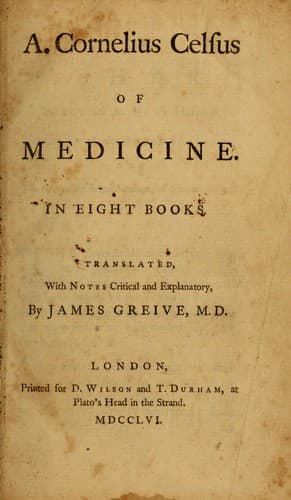
Of Medicine, in Eight BooksCelsus, Aulus Cornelius
History
Of Medicine, in Eight Books
Celsus, Aulus Cornelius
Medicine, Greek and Roman
But as the fever and the manner of its remission direct to the proper
seasons for food and drink, so it is not very easy to know, when the
patient has a fever upon him, when he is better, or when his strength
fails; without which these cannot be properly administered. For we
principally trust the pulse, a most fallacious mark; because this is
often slower or more quick from the age, and sex, and difference of
constitutions. And generally when the body is in good enough health,
if the stomach be weak, sometimes also in the beginning of a fever,
it rises and sinks; so that the person may seem to be weak, when he
can very well stand a severe fit that is just approaching. On the
other hand, the pulse is often raised, and the vessels relaxed by the
influence of the sun, and the bath, and exercise, and fear, and anger,
and any other passion of the mind. So that, when a physician first
comes in, the anxiety of the patient, doubtful how he may think him,
accelerates the pulse. For this reason it is the business of a skilful
physician not to take hold of the patient’s arm with his hand, as soon
as he comes in; but first to sit down with a cheerful countenance, and
ask him how he does; and if he has any apprehension, to encourage him
with plausible discourse: then to apply his hand to his wrist(5).
Now if the sight of the physician quickens the pulse, how easily may a
thousand other accidents disorder it! Another mark, to which we trust,
is heat, equally deceitful; for this is excited by warmth, labour,
sleep, fear, and anxiety.
Wherefore it is fit to consider those things; but not to trust
entirely to them. And we may at once assure ourselves that a
person has no fever, whose pulse moves regularly, and who has such
a heat as is common to people in health; and that a fever is not
necessarily breeding, when there is heat and motion; but only with
these circumstances, if the surface of the skin, be unequally dry; if
there be a heat in the forehead, and at the same time arising from
the internal part of the præcordia; if the breath rushes out of the
nostrils very hot; if the colour be changed either for a redness or
an unusual paleness; if the eyes are heavy, and either very dry or
somewhat moist; if when a sweat comes on, it is partial; if the pulse
does not beat at equal intervals. Upon this account the physician ought
to sit down neither in the dark, nor at the patient’s head, but in a
light place opposite to him, that he may take all the marks from the
countenance of the patient as he lies.
Public-domain text, read in full here on John Shaqi.
Reviews
Reviews
No reviews yet
Be the first to share your thoughts on this work.
Elsewhere in the archive
Join the Discussion
Join the discussion
Sign in to leave a comment or review.
Sign InorCreate an account