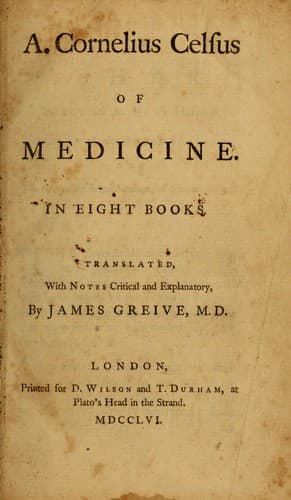
Of Medicine, in Eight BooksCelsus, Aulus Cornelius
History
Of Medicine, in Eight Books
Celsus, Aulus Cornelius
Medicine, Greek and Roman
For an example of the reduction of Celsus’s weights to ours, the
following may serve.
Lib. v. cap. 19. no. 7. Philotas’s plaister contains,
Of Eretrian earth ℥ Ʒ ℈ gr.
-- chalcitis, each p. iv.*. == 1/2 : 0 : 0 : 8 viz. Ʒi. gr. ii.
-- myrrh multiplied by 4
-- calcined copper, each p. x.*. == 1 : 2 : 1 : 0 --and so all
-- isinglass p. vi. *. == 0 : 6 : 0 : 12 the rest.
-- rasile verdigrease
-- round allum
-- crude misy
-- birthwort, of each p. viii.*. == 1 : 0 : 0 : 16
-- copper scales p. xx.* == 2-1/2 : 0 : 2 : 0
-- male frankincense, p. ii.*. == 0 : 2 : 0 : 4
-- oil of roses
-- Bitter oil, of each three cyathi, or 1 quartarius == between 1/4
and 1/3 of an English pint.
-- vinegar, a sufficient quantity.
ERRATA,
IN THE TEXT.
Page 110 line 9 _for_ substances, _read_ medicines.
---- 189 ---- 26 _for_ flour _read_ flower.
---- 240 ---- 22 _for_ warm ingremedies _read_ warming remedies.
---- 249 ---- 14 _for_ comes _read_ come.
---- 257 ---- 30 _for_ verjuice _read_ omphacium.
---- 271 ---- 16 _for_ wines _read_ wine.
---- 323 ---- 31 _for_ straight _read_ strait.
---- 350 ---- 18 _dele_ also.
A. CORNELIUS CELSUS
OF
MEDICINE.
_BOOK I._
PREFACE.
As agriculture promises food to the healthy, so medicine promises
health to the sick. There is no place in the world, where this art is
not found: for even the most barbarous nations are acquainted with
herbs, and other easy remedies for wounds and diseases. However it has
been more improved by the Greeks than any other people: though not
from the infancy of that nation, but only a few ages before our own
times; as appears by their celebrating Æsculapius as its most ancient
author; who, because he cultivated this science with somewhat more
accuracy, which, before him, was rude and of low esteem, was received
into the number of their gods.(1) After him his two sons, Podalirius
and Machaon, following Agamemnon to the Trojan war, were not a little
useful to their fellow soldiers. But even these, according to Homer’s
account, did not undertake the plague, nor the other various kinds of
diseases, but only cured wounds by incisions, and medicines: from which
it appears, that they entirely confined themselves to the chirurgical
part of medicine, and that this was the most antient branch. From the
same author we may also learn, that diseases were then believed to
arise from the anger of the immortal gods,(2) and that relief used
to be sought from them. It is also probable, that though there were
few remedies for distempers known, men nevertheless generally enjoyed
good health from the sobriety of their lives, yet untainted by sloth
and luxury. For these two vices, first in Greece, and then among
us, rendered men liable to many diseases. And hence that variety of
Public-domain text, read in full here on John Shaqi.
Reviews
Reviews
No reviews yet
Be the first to share your thoughts on this work.
Join the Discussion
Join the discussion
Sign in to leave a comment or review.
Sign InorCreate an account