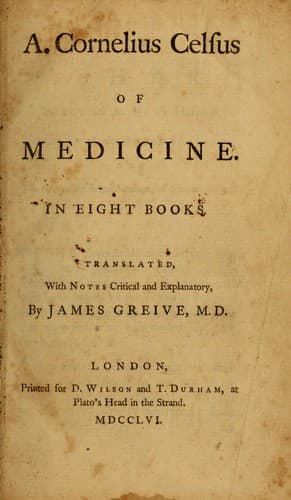
Of Medicine, in Eight BooksCelsus, Aulus Cornelius
History
Of Medicine, in Eight Books
Celsus, Aulus Cornelius
Medicine, Greek and Roman
remedies now used, which was neither necessary in ancient times, nor
is yet in other nations, scarcely protracts the lives of a few of us
to the verge of old age. For the same reason, after those, whom I have
mentioned, no men of eminence practised medicine, till learning began
to be pursued with greater application; which, as it is of all things
most necessary to the mind, so it is no less hurtful to the body. And
at first the science of healing was accounted a branch of philosophy;
so that the cure of diseases, and the study of nature, owed their rise
to the same persons: and for this very good reason, because they, who
had impaired their bodies by anxious thought, and nightly watchings,
stood most in need of its assistance. And thus we find, that many
amongst the philosophers were skilled in this science; of whom the most
celebrated were Pythagoras, Empedocles, and Democritus. Hippocrates
of Cos, who, according to some authors, was the disciple of the last
mentioned of these, and is so justly admired both for his knowledge in
this profession, and for his eloquence, was the first worthy of notice,
who separated medicine from the study of philosophy. After him, Diocles
the Carystian, then Praxagoras and Chrysippus; after these, Herophilus
and Erasistratus applied themselves to this art, and differed widely
from each other in their methods of cure.
(1) For references 1, 2, 3, &c. see Notes at the end.
During this period, physick was divided into three parts: the
first cured by diet, the second by medicines, the third by manual
operations: the first they termed, in Greek, Diætetice,[X] the second
Pharmaceutice,[Y] and the third Chirurgice.[Z] The most illustrious
professors of that branch, which treats diseases by diet, endeavoured
to extend their views farther, and took in the assistance of natural
philosophy; being persuaded that, without it, medicine would be a
weak and imperfect science. After these came Serapion, who first
of all maintained, that the rational method of study was foreign to
the art of medicine, and confined it to practice and experience. In
his steps followed Appollonius and Glaucias, and some time after
Heraclides of Tarentum, and others of no small note; who, from the
doctrine they asserted, stiled themselves Empiricks[AA]. And thus the
Dietetick branch was also divided into two parts, one set of physicians
pursuing theory, the other following experience alone. However, after
these we have enumerated above, no one attempted any thing new, till
Asclepiades, who greatly changed the art of medicine. And Themison, one
of his successors, has also lately, in his old age, departed from him
in some things. And these are the men, to whom we are chiefly indebted
for the improvements made in this salutary profession.
[X] Διαιτητικὴ.
[Y] Φαρμακευτικὴ.
[Z] Χειρουργικὴ.
[AA] Εμπειρικοὶ.
Public-domain text, read in full here on John Shaqi.
Reviews
Reviews
No reviews yet
Be the first to share your thoughts on this work.
Join the Discussion
Join the discussion
Sign in to leave a comment or review.
Sign InorCreate an account