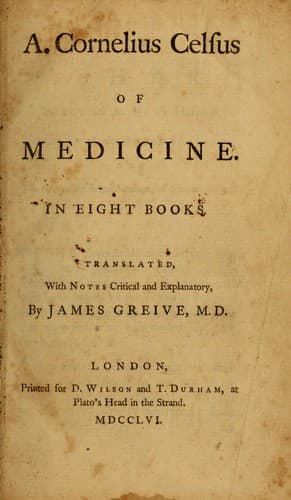
Of Medicine, in Eight BooksCelsus, Aulus Cornelius
History
Of Medicine, in Eight Books
Celsus, Aulus Cornelius
Medicine, Greek and Roman
Those actions of the body which
they call natural, are inspiration and exspiration, the reception and
concoction of our meat and drink, as also the distribution(5) of
the same into the several parts of the body. They also inquire how it
happens, that our arteries rise and fall; from what causes proceed
sleep and watching; without the knowledge of which, they conceive it
impossible for any person either to oppose the beginnings of diseases,
that depend on these particulars, or cure them when formed. As of
all these things they look upon concoction to be of the greatest
importance, they insist chiefly upon it; and some of them following
the opinion of Erasistratus, affirm that the food is concocted in
the stomach by attrition; others, after Plistonicus, the disciple of
Praxagoras, by putrefaction; others, upon the credit of Hippocrates,
believe concoction is effected by heat. After them follow the disciples
of Asclepiades, who hold all these hypotheses to be vain and idle;
for that there is no concoction at all, but the matter, crude as it
is received, is distributed through the whole body. And in these
things they are by no means agreed: however, it is not disputed, that
according to the different hypotheses, a different regimen of diet is
to be observed by sick people. For if it be performed by attrition,
such food is to be chosen, as will most easily be broken to pieces; if
by putrefaction, such as most quickly undergoes that change; if heat
be the cause of concoction, then such as most effectually cherishes
heat. But if there be no concoction at all, then none of these kinds
of aliment are to be chosen: but such are to be taken, as are least
liable to change from the state in which they are received. And, by
the same way of reasoning, when there is a difficulty of breathing,
when sleep or watchings oppress, they are of opinion, that the man,
who has first learned in what manner these happen, will be capable of
curing them. Besides, as pains, and various other disorders, attack
the internal parts, they believe no person can apply proper remedies
to those parts, which he is ignorant of; and therefore, that it is
necessary to dissect dead bodies, and examine their viscera and
intestines; and that Herophilus and Erasistratus had taken far the best
method _for attaining that knowledge_, who procured criminals out of
prison, by royal permission, and dissecting them alive, contemplated,
while they were even breathing, the parts, which nature had before
concealed; considering their position, colour, figure, size, order,
hardness, softness, smoothness, and asperity(6); also the processes
and depressions of each, or what is inserted into, or received by
another part; for, _say they_, when there happens any inward pain, a
person cannot discover the seat of that pain, if he have not learned
where every viscus or intestine is situated; nor can the part, which
suffers, be cured by one, who does not know what part it is; and that
Public-domain text, read in full here on John Shaqi.
Reviews
Reviews
No reviews yet
Be the first to share your thoughts on this work.
Join the Discussion
Join the discussion
Sign in to leave a comment or review.
Sign InorCreate an account