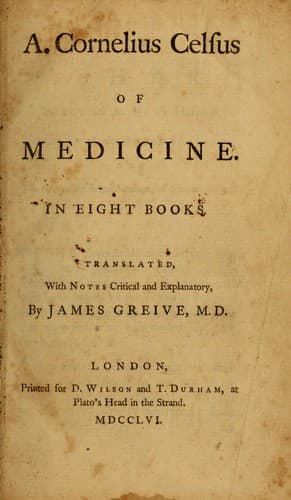
Of Medicine, in Eight BooksCelsus, Aulus Cornelius
History
Of Medicine, in Eight Books
Celsus, Aulus Cornelius
Medicine, Greek and Roman
As that branch of medicine, which respects the cure of diseases, is the
noblest, as well as the most difficult of the three, we shall first
treat of that part. And because in this the chief dispute is, that some
alledge an acquaintance with experiments to be only requisite, while
others affirm experience alone to be insufficient, without a thorough
knowledge of the constitution of bodies, and what naturally happens
to them; it will be proper to recite the principal arguments on both
sides, that we may the more easily deliver our own opinion upon the
question.
Those then, who declare for a theory in medicine, look upon the
following things as necessary: the knowledge of the occult and
constituent causes of distempers; next, of the evident ones; then, of
the natural actions; and, lastly, of the internal parts. They call
these causes occult, in which we inquire of what principles our bodies
are composed, what constitutes health, and what sickness. For they
hold it impossible that any one should know how to cure diseases, if
he be ignorant of the causes, whence they proceed; and that it is not
to be doubted, but one method of cure is required, if the redundancy
or deficiency in any of the four principles(3) be the cause of
diseases, as some philosophers have affirmed; another, if the fault
lie wholly in the humours, as Herophilus thought; another, if in
the inspired air, as Hippocrates believed; another, if the blood be
transfused into those vessels(4), which are designed only for air,
and occasion an inflammation, which the Greeks call phlegmone[AB], and
that inflammation cause such a commotion as we observe in a fever,
which was the opinion of Erasistratus; another, if the corpuscles
passing through the invisible pores should stop, and obstruct the
passage, as Asclepiades maintained: that he will proceed in the proper
method of curing a disease, who is not deceived in its original cause.
Nor do they deny experience to be necessary, but affirm, it cannot be
obtained without some theory; for that the more ancient practitioners
did not prescribe any thing, at hazard, for the sick, but considered
what was most suitable, and examined that by experience, to which they
had before been led by some conjecture. That it is of no moment _in
this argument_, whether most remedies were discovered by experiment,
provided they were at first applied with some rational view: and that
this holds in many cases; but new kinds of distempers often occur, in
which practice has hitherto given no light; so that it is necessary
to observe whence they arose; without which no mortal can find out,
why he should make use of one thing, rather than another. And for
these reasons they investigate the occult causes. They term those
causes evident, in which they inquire, whether the beginning of the
distemper was occasioned by heat or cold, fasting or surfeit, and the
like. For they say, he will be able to oppose the first appearances,
who is not ignorant of their rise.
Public-domain text, read in full here on John Shaqi.
Reviews
Reviews
No reviews yet
Be the first to share your thoughts on this work.
Join the Discussion
Join the discussion
Sign in to leave a comment or review.
Sign InorCreate an account