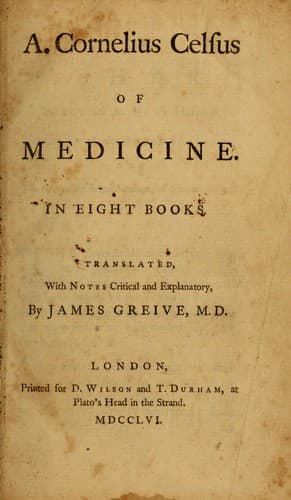
Of Medicine, in Eight BooksCelsus, Aulus Cornelius
History
Of Medicine, in Eight Books
Celsus, Aulus Cornelius
Medicine, Greek and Roman
divided, but from experiments, according as they had succeeded in the
course of their practice. That medicine, even in its infancy, was not
deduced from these inquiries, but from experiments: for of the sick,
who had no physicians, some from a keen appetite, had immediately
taken food in the first days of their illness, while others feeling a
nausea, had abstained from it; and that the disorder of those, who had
abstained, was more alleviated; also, some in the paroxysm of a fever
had taken food, others a little before it came on, and others after its
remission; and that it succeeded best with those who had done it after
the removal of the fever: in the same manner some used a full diet in
the beginning of a disease; others were abstemious; and that those
grew worse, who had eaten plentifully. These and the like instances
daily occurring, that diligent men observed attentively, what method
generally answered best, and afterwards began to prescribe the same to
the sick. That this was the rise of the art of medicine, which by the
frequent recovery of some, and the death of others, distinguishes what
is pernicious from what is salutary; and that when the remedies were
found, men began to discourse about the reasons of them: that medicine
was not invented in consequence of their reasoning, but the theory
was sought for after the discovery of medicine. They ask too, whether
reason prescribes the same as experience, or something different; if
the same, they infer it to be needless, if different, mischievous.
That at first, however, there was a necessity for examining remedies
with the greatest accuracy, but now they are sufficiently ascertained;
and that we neither meet with any new kind of disease, nor want any
new method of cure. That if some unknown distemper should occur, the
physician would not therefore be obliged to have recourse to the occult
things; but he would presently see to what distemper it is most nearly
allied, and make trial of remedies like to those, which have often been
successful in a similar malady, and by the resemblance between them
would find some proper cure. For they do not affirm, that judgment is
not necessary to a physician, and that an irrational animal is capable
of practising this art; but that those conjectures, which relate to the
occult things, are of no use; because it is no matter what causes, but
what removes a distemper: nor is it of any importance in what manner
the distribution is performed, but what is most easily distributed;
whether concoction fails from this cause or that; or whether it be
properly a concoction, or only a distribution: nor are we to inquire
how we breathe, but what relieves a difficult and slow breathing; nor
what is the cause of motion in the arteries, but what each kind of
motion indicates. That these things are known by experience: that in
all disputes of this kind, a good deal may be said on both sides; and
therefore genius and eloquence obtain the victory in the dispute; but
Public-domain text, read in full here on John Shaqi.
Reviews
Reviews
No reviews yet
Be the first to share your thoughts on this work.
Join the Discussion
Join the discussion
Sign in to leave a comment or review.
Sign InorCreate an account