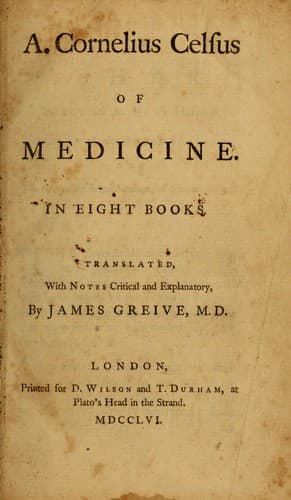
Of Medicine, in Eight BooksCelsus, Aulus Cornelius
History
Of Medicine, in Eight Books
Celsus, Aulus Cornelius
Medicine, Greek and Roman
diseases are cured not by eloquence, but by remedies; so that if a
person, without any eloquence, be well acquainted with those remedies,
that have been discovered by practice, he will be a much greater
physician than one who has cultivated his talent in speaking without
experience. That these things, however, which have been mentioned, are
only idle: but what remains is also cruel, to cut open the abdomen and
præcordia of living men, and make that art, which presides over the
health of mankind, the instrument, not only of inflicting death, but
of doing it in the most horrid manner; especially if it be considered,
that some of those things, which are sought after with so much
barbarity, cannot be known at all, and others may be known without
any cruelty; for that the colour, smoothness, softness, hardness,
and such like, are not the same in a wounded body, as they were in
a sound; and further, because these qualities, even in bodies that
have suffered no external violence, are often changed by fear, grief,
hunger, indigestion, fatigue, and a thousand other inconsiderable
disorders; which makes it much more probable, that the internal parts,
which are far more tender, and never exposed to the light itself, are
changed by the severest wounds and mangling. And that nothing can be
more ridiculous than to imagine any thing to be the same in a dying
man, nay one already dead, as it is in a living person: for that the
abdomen(8) indeed may be opened(9), while a man breathes; but as
soon as the knife has reached the præcordia(10), and the transverse
septum is cut, which by a kind of membrane divides the upper from the
lower parts, (and by the Greeks is called the Diaphragm[AC]) the man
immediately expires; and thus the præcordia, and all the viscera never
come into the view of the butchering physician, till the man is dead;
and they must necessarily appear as those of a dead person, and not
as they were while he lived; and thus the physician gains only the
opportunity of murdering a man cruelly, and not of observing, what are
the appearances of the viscera in a living person: if, however, there
be any thing which can be observed in a person, that yet breathes,
chance often throws it in the way of such as practise the healing art;
for that sometimes a gladiator on the stage, a soldier in the field,
or a traveller beset by robbers, is so wounded, that some internal
part, different in different people, may be exposed to view; and thus
a prudent physician finds their situation, position, order, figure,
and the other particulars he wants to know, not perpetrating murder,
but attempting to give health; and learns that, by compassion, which
others had discovered by horrid cruelty. That for these reasons it is
not necessary to lacerate even dead bodies; which, though not cruel,
yet may be shocking to the sight, since most things are different in
dead bodies; and even the dressing of wounds shows all that can be
discovered in the living.
[AC] Διάφραγμα.
Public-domain text, read in full here on John Shaqi.
Reviews
Reviews
No reviews yet
Be the first to share your thoughts on this work.
Join the Discussion
Join the discussion
Sign in to leave a comment or review.
Sign InorCreate an account