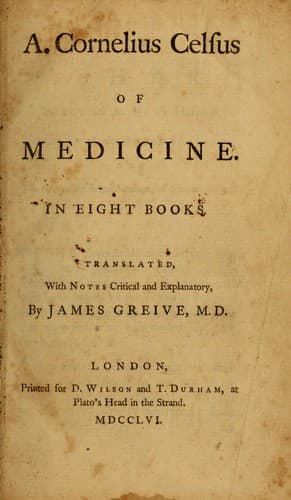
Of Medicine, in Eight BooksCelsus, Aulus Cornelius
History
Of Medicine, in Eight Books
Celsus, Aulus Cornelius
Medicine, Greek and Roman
occurs, the physician ought to invent something, which though perhaps
it does not always answer, yet most commonly may: and he shall draw
his new method, not from the occult things (for they are dubious and
uncertain) but from those, that can be fully known, that is, from the
evident causes. For it makes a considerable difference, whether the
distemper was occasioned by fatigue, or thirst, or cold, or heat,
or watching, or hunger; or whether it arose from too much food and
wine, or excess of venery. And he ought not to be ignorant of the
constitution of his patient, whether his body be too moist, or too dry:
whether his nerves(12) be strong or weak; whether he be frequently
or seldom ailing; and whether his illnesses are severe or slight, of
long continuance or short; what way of life he has pursued, laborious
or sedentary, luxurious or frugal; for from these, and such like
circumstances, he must often draw a new method of cure.
Nevertheless even these things ought not to be so passed over, as
if they were uncontroverted; for Erasistratus has affirmed, that
distempers were not occasioned by them, because other people, and even
the same person at different times, would not fall into a fever upon
them. And some of the Methodists of our own age, from the authority of
Themison (as they would have it thought) assert, that the knowledge of
no cause whatever bears the least relation to the method of cure; and
that it is sufficient to observe some general symptoms of distempers;
and that there are three kinds of diseases, one bound, another
loose(13), and the third a mixture of these. For that sometimes the
excretions of sick people are too small, sometimes too large; and
sometimes one particular excretion is deficient, while another is
excessive. That these kinds of distempers are sometimes acute, and
sometimes chronic; sometimes increasing, sometimes at a stand(14),
and sometimes abating. As soon then as it is known, to which of these
classes a distemper belongs if the body be bound, it must be opened;
if it labours under a flux, it must be restrained; if the distemper be
complicated, then the most urgent malady must be first opposed. And
that one kind of treatment is required in acute, another in inveterate
distempers; another, when diseases are increasing; another, when at
a stand; and another, when inclining to health. That the observation
of these things constitutes the art of medicine, which they define
as a certain way of proceeding, which the Greeks call _Method_[AD],
and affirm it to be employed in considering those things, that are in
common to the same distempers: nor are they willing to have themselves
classed either with the rationalists, or with those, who regard only
experiments; for they dissent from the first sect, in that they will
not allow medicine to consist in forming conjectures about the occult
things; and also from the other in this, that they hold the observation
of experiments to be a very small part of the art.
Public-domain text, read in full here on John Shaqi.
Reviews
Reviews
No reviews yet
Be the first to share your thoughts on this work.
Join the Discussion
Join the discussion
Sign in to leave a comment or review.
Sign InorCreate an account