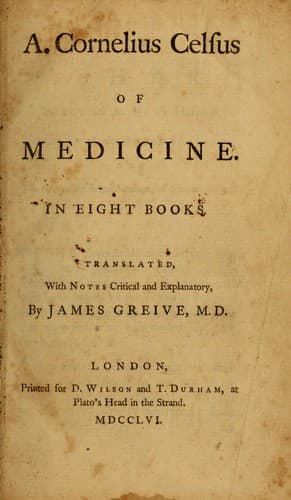
Of Medicine, in Eight BooksCelsus, Aulus Cornelius
History
Of Medicine, in Eight Books
Celsus, Aulus Cornelius
Medicine, Greek and Roman
Since these points have often been, and still continue to be disputed
with great warmth by physicians in large volumes, ’tis proper to add
some reflections, that may seem to come the nearest to the truth, and
which neither slavishly follow either of these opinions, nor are too
remote from both, but lie, as it were, in the middle, betwixt these
opposite extremes; which those, that inquire after truth without
partiality, may find to be the surest method for directing the judgment
in most warm controversies, as well as in this now before us. For,
with regard to the causes of health or diseases, in what manner the
air, or food, is either conveyed or distributed, the philosophers
themselves do not attain to an absolute certainty; they only make
probable conjectures. Now, when there is no certain knowledge of a
thing, a mere opinion about it cannot discover a sure remedy. And it
must be owned, that nothing is of greater use, even to the rational
method of curing, than experience. Altho’ then many things are taken
into the study of arts, which do not, properly speaking, belong to
the arts themselves, yet they may greatly improve them by quickening
the genius of the artist; wherefore the contemplation of nature,
though it cannot make a man a physician, yet may render him fitter
for the practice of medicine. Indeed, it is very probable, that both
Hippocrates and Erasistratus, and all the others, who were not content
with treating fevers and ulcers, but examined in some measure into the
nature of things, tho’ they did not by such study become physicians,
yet became more able physicians by that means. And medicine itself
requires the help of reason, if not always amongst the occult causes,
or the natural actions, yet often; for it is a conjectural art; and
not only conjecture in many cases, but even experience is found not
consistent with its rules. And sometimes neither fever, nor appetite,
nor sleep, follow their usual antecedents in the regular course. A new
distemper sometimes, though very seldom, appears; that such a case
never happens is manifestly false; for, in our own time, a certain
lady, from a quantity of flesh(11) falling down from her private
parts, and growing dry, expired in a few hours; so that the most
celebrated physicians neither found out the genus of the distemper,
nor any remedy for it. I suppose the reason they forbore to attempt
any thing was, that none of them was willing to run a risk upon his
own conjecture only in a person of her quality, for fear he should be
thought to have killed, if he did not save her; yet it is probable
that some one, without that regard to the opinion of the world, might
have contrived something, which upon trial would have succeeded. Nor
is a similitude always serviceable in this kind of practice; and
where it is, this properly belongs to the rational part, to consider
amidst a number of similar kinds, both of diseases and remedies, what
particular medicine ought to be preferred. When such an incident
Public-domain text, read in full here on John Shaqi.
Reviews
Reviews
No reviews yet
Be the first to share your thoughts on this work.
Join the Discussion
Join the discussion
Sign in to leave a comment or review.
Sign InorCreate an account