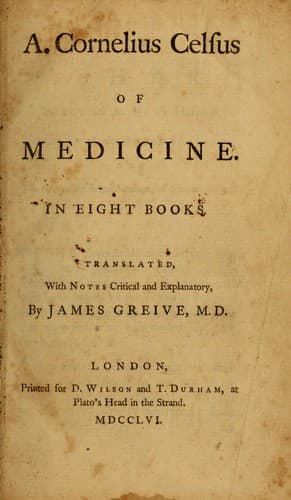
Of Medicine, in Eight BooksCelsus, Aulus Cornelius
History
Of Medicine, in Eight Books
Celsus, Aulus Cornelius
Medicine, Greek and Roman
I might have urged many passages in this book to prove that he was a
physician, if I had not reason to think the present age is already
satisfied in that point. There are two, however, so remarkable, that
they ought not to be omitted. When our author is considering the proper
time for allowing nourishment, after saying that some gave their
patients food in the evening, he gives reasons against that method,
and then adds, “_Ob haec ad mediam noctem decurro_, i. e. For these
reasons I defer it till midnight.” Thus most of the older copies read,
and also Morgagni’s manuscript; so that Linden is not easily to be
forgiven for making alterations in so material a place[P]. In the other
passages there is no variation in the reading. In that species of the
ancyloblepharon, where the eye-lid unites with the white of the eye,
our author, after describing the method of cure, immediately adds,
“_Ego sic restitutum neminem memini. Meges se quoque multa_, &c. _i.
e._ I do not remember an instance of any person cured in this way.
Meges also has told us that he has tried many methods, and never was
successful, because the eye-lid always united again to the eye[Q].” The
form of expression here used by our author, in a manner peculiar to
a practitioner, would come very improperly from a mere compiler. The
connection of these two sentences by _quoque_ seems to put our author’s
own observation upon the same footing with that of Meges, whom he
quotes on several occasions as a most accomplished surgeon[R].
[P] Lib. iii. c. 5.
[Q] Lib. vii. c. 7. See Le Clerc.
[R] Though numberless passages will occur in the course of the book,
where Celsus expressly delivers his own judgment, yet as the reader
may perhaps chuse to have some of the most remarkable at one view,
the following references will serve for that purpose. Lib. i. c. 3.
p. 30. _Neque ignoro_, &c. _Commoneo tamen_, &c. Lib. ii. c. 14. p.
88. _Quas tamen_, &c. p. 89. _Neque ignoro quosdam_, &c. Lib. iii. c.
2. p. 140. _Ego tum hoc puto_, &c. c. 14. p. 144. _Tutius tamen_, &c.
c. 18. p. 150. _Quid igitur est_, &c. Lib. iv. c. 4. p. 200. _Melius
huic rei_, &c. c. 17. p. 227. _Interdum teretes videmus_, &c. c. 19.
p. 230. _Ego experimentis_, &c. Lib. vi. c. 4. p. 345. _Sed nihil
melius est_, &c. Lib. vii. c. 12. p. 446. _Ego autem cognovi_, &c.
c. 14. p. 450. _Sed abunde est_, &c. Lib. viii. c. 2. p. 509. _Neque
audiendi_, &c. c. 3. p. 512. _Ut quando os perrumpitur, sentiamus_,
&c. c. 4. p. 517. _Sed multo melius est_, &c. c. 8. p. 528. _Ex
dolore colligimus_, &c. c. 13. p. 546. _Ponendum autem hoc esse
credidi_, &c. Any person, who will be at the pains to examine these
passages, will easily see, that they strongly support the conclusion
drawn from the two above recited. [See Linden or Almeloveen’s
edition.]
Public-domain text, read in full here on John Shaqi.
Reviews
Reviews
No reviews yet
Be the first to share your thoughts on this work.
Join the Discussion
Join the discussion
Sign in to leave a comment or review.
Sign InorCreate an account