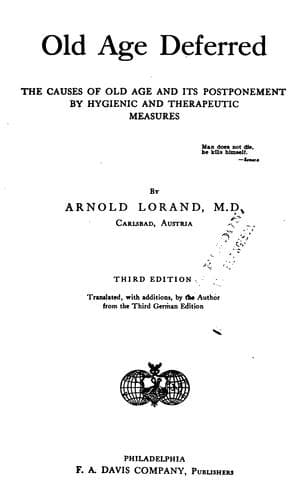
Old Age Deferred: The causes of old age and its postponement by hygienic and therapeutic measuresLorand, Arnold
Science
Old Age Deferred: The causes of old age and its postponement by hygienic and therapeutic measures
Lorand, Arnold
Hygiene; Longevity; Old age
These experiments prove that the bile contains poisonous substances,
including pathogenic bacteria in an attenuated condition, and also that
it has antitoxic properties. Thus we may understand how it can
neutralize putrefactive products from the intestines. Not only bacteria,
but all the various kinds of poison which the liver destroys, are
eliminated by the bile; hence the importance of a free circulation of
this fluid. The liver serves as a depot for metallic substances like
iron and copper, and also for the more dangerous ones such as lead,
mercury, arsenic, or antimony. After first keeping them in storage, it
then attempts to eliminate these noxious substances. According to
Slowzoff and Bamossi, the various poisonous metals and alkaloids enter
into combinations with the proteid bodies of the liver. Animals that
have been richly fed have been found to be better protected against
these poisons because of their livers being richer in proteid contents
and glycogen.
The liver also protects the body against the numerous toxic products
formed in the stomach and intestines during the process of digestion and
assimilation. The most important of these are the carbamins and ammonia
salts, which would be injurious to us if the liver did not protect us by
converting them into urea.
When the liver is excluded from the circulation, as Nencky and his
pupils have done by establishing an Eck fistula, toxic symptoms arise
when the animals are given albuminous food, and these symptoms can only
be explained from the fact that the liver is unable to destroy toxic
products. The more albuminous food taken, the more marked are the
symptoms of intoxication.
The liver aids in the transformation of the poisonous end-products of
proteid metabolism by bringing about the combination of the toxic
end-products with sulphuric acid (Baumann, Emden and Glaesner). Thus
these dangerous substances are eliminated as ethereal sulphates, which
are practically harmless. Even when these ethereal sulphates are present
in large amounts in the urine there may be no symptoms of
auto-intoxication.
When the liver is extirpated, a condition of acidosis arises, and a
large quantity of ammonia is eliminated, which is produced in order to
neutralize the acids present. The liver protects us against acids formed
in the organism. After eating a quantity of meat, we would be menaced by
the acids formed through its decomposition, were the liver not active.
We can prevent acidosis if we eat a considerable amount of
carbohydrates, at least 100 grammes a day as Hirschfeld has proved. It
has been shown by Waldvogel that these carbohydrates do not prevent
acidosis if they are given by a method which precludes their passage
through the portal circulation,—e.g., subcutaneously.
Public-domain text, read in full here on John Shaqi.
Reviews
Reviews
No reviews yet
Be the first to share your thoughts on this work.
Elsewhere in the archive
Join the Discussion
Join the discussion
Sign in to leave a comment or review.
Sign InorCreate an account