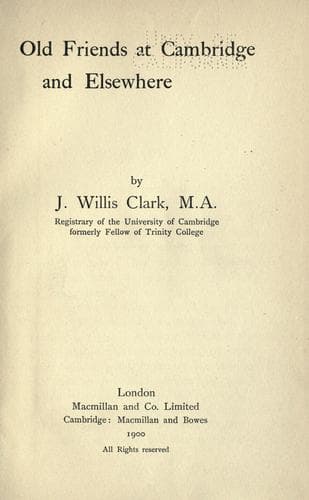
Old Friends at Cambridge and ElsewhereClark, John Willis
History
Old Friends at Cambridge and Elsewhere
Clark, John Willis
University of Cambridge -- History
Throughout his life Milnes approached public events with a singular
sobriety of judgment. He was never led away by popular clamour, but
formed his opinions, on principle, after mature deliberation. It is
almost needless to add that he generally found himself on the unpopular
side. When England went mad over the Crimean war, Milnes wrote calmly:
‘For my own part I like neither of the combatants, though I prefer a
feeble and superannuated despotism as less noxious to mankind than one
young and vigorous, and assisted by the appliances of modern
intelligence.’ During the American civil war, he ‘broke away from his
own class, and ranged himself on the side of the friends of the North,
with an earnestness not inferior to that of Mr Bright and Mr Forster.’
Mr Reid tell us that this conduct won for Milnes that popularity with
the masses, especially in Yorkshire and Lancashire, which all his
previous efforts had failed to obtain, and that he found himself, to his
great surprise, one of the popular idols. In 1870, again, he was on the
unpopular side: ‘I am Prussian to the backbone,’ he wrote, ‘which is a
pure homage to principle, as they are the least agreeable people in the
world.’
We have been at pains to set forth Milnes’s political acts and
convictions in some detail, because he has been frequently represented
as a gay _farceur_, who took up politics as a pastime. It is not,
however, as a politician that he will be remembered, but as a man of
letters. In his younger days he achieved distinction as a writer of
verse, and Landor hailed him as ‘the greatest poet now living in
England.’ This judgment may nowadays provoke a smile; but, though it is
not to be expected that his poems will recover their former popularity,
they hardly deserve to have fallen into complete neglect. As Mr Reid
says:
‘A great singer he may not have been; a sweet singer with a charm of his
own he undoubtedly was; nor did his charm consist alone in the melody of
which he was a master. In many of his poems real poetic thought is
linked with musical words; whilst in everything that he wrote, whether
in verse or in prose, one may discern the brightest characteristics of
the man himself: the catholicity of his spirit; the tenderness of his
sympathy with weakness, suffering, mortal frailty in all its forms; the
ardour of his faith in something that should break down the artificial
barriers by which classes are divided, and bring into the lives of all a
measure of that light and happiness which he relished so highly for
himself’ (vol. ii. p. 438).
Public-domain text, read in full here on John Shaqi.
Reviews
Reviews
No reviews yet
Be the first to share your thoughts on this work.
Elsewhere in the archive
Join the Discussion
Join the discussion
Sign in to leave a comment or review.
Sign InorCreate an account