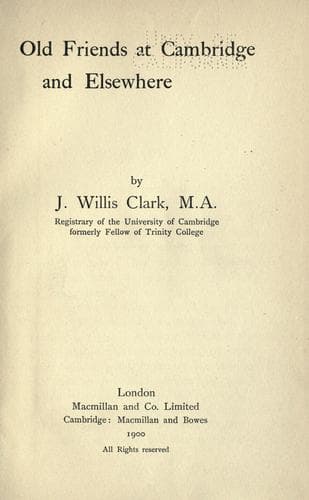
Old Friends at Cambridge and ElsewhereClark, John Willis
History
Old Friends at Cambridge and Elsewhere
Clark, John Willis
University of Cambridge -- History
Advancing years and disappointed hopes caused no abatement in his
interest in foreign affairs. The events of 1848 had been specially
interesting to him; and at the close of that year he produced what Mr
Reid well describes as ‘a striking and instructive’ pamphlet, entitled
_A Letter to the Marquis of Lansdowne_. The author reviews the events of
the year, and supports the thesis that ‘the Liberals of the Continent
had not proved themselves unworthy of the sympathy of England.’ We have
no room for an analysis of this masterly work, but we cannot refrain
from quoting one remarkable passage in which he foreshadows French
intervention in Italy. After describing measures by which Austria
intended to make the Lombardo-Venetian kingdom a second Poland, he
proceeds:
‘And France, whatever be her adventures in government, will not easily
have so dulled her imagination or quelled her enthusiasm as to be
unmoved by appeals to the deeds of Marengo and Lodi, and to suffer an
expiring nation at her very door to cry in vain for help and protection,
not against the restraints of an orderly authority, but against fierce
invaders intent upon her absolute destruction’ (vol. i. p. 413).
This pamphlet made a great sensation. In England it was received, for
the most part, with dislike and apprehension. Carlyle was almost alone
in praising it. ‘Tell him,’ he said, ‘it is the greatest thing he has
yet done; earnest and grave, written in a large, tolerant, kind-hearted
spirit, and, as far as I can see, saying all that is to be said on
_that_ matter.’ But the strongest proof of the power of the pamphlet is
the fact that the Austrians stopped the writer on the Hungarian frontier
when travelling with his wife in 1851, as a person who could not breathe
that revolutionary atmosphere without danger to the empire. In his later
years foreign travel became almost a necessity to Lord Houghton; and as
he had then fewer ties to bind him to England, his absences were more
frequent and more prolonged. He travelled in France, no longer as an
envoy without credentials, but for his private information, or to be the
guest of Guizot and De Tocqueville; he became the friend of the
accomplished Queen of Holland; he represented the Geographical Society
at the opening of the Suez Canal; he made a triumphal progress through
the United States; and only three years before his death he went again
to Egypt and Greece.
Public-domain text, read in full here on John Shaqi.
Reviews
Reviews
No reviews yet
Be the first to share your thoughts on this work.
Elsewhere in the archive
Join the Discussion
Join the discussion
Sign in to leave a comment or review.
Sign InorCreate an account