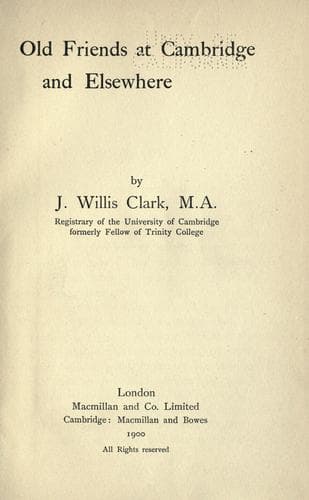
Old Friends at Cambridge and Elsewhere — John Shaqi
Old Friends at Cambridge and ElsewhereClark, John Willis
History
Old Friends at Cambridge and Elsewhere
Clark, John Willis
University of Cambridge -- History
In October 1812 he commenced residence at Trinity College as a
sub-sizar. His first University distinction was the Chancellor’s gold
medal for English Verse, the subject being ‘Boadicea.’ In after years he
was fond of expressing the theory that ‘a prize-poem should be a
prize-poem’: by which he probably meant that the subject should be
treated in a conventional fashion, with no eccentric innovations of
style or metre. It must be admitted that his own work conformed exactly
to this standard. The poem was welcomed with profound admiration in the
family circle at home; but his old master took a different view of the
question. Professor Owen relates that Mr Rowley called one day at his
mother’s house, and began as follows:
‘“I’ve sad news for you, Mrs Owen, to-day. I’ve just had a letter from
Cambridge; that boy Whewell has ruined himself, he’ll never get his
Wranglership now!” “Why, good gracious, Mr Rowley, what _has_ Whewell
been doing?” “Why, he has gone and got the Chancellor’s gold medal for
some trumpery poem, ‘Boadicea,’ or something of that kind, when he ought
to have been sticking to his mathematics. I give him up now. Taking
after his poor mother, I suppose.”’
The letters which he wrote home give us some pleasant glimpses of his
College life, which he evidently thoroughly enjoyed. For the first time
in his life he had access to a good library—that of Trinity College—and
he speaks of ‘an inconceivable desire to read all manner of books at
once,’ adding that at that very moment there were two folios and six
quartos of different works upon his table. The success which he
afterwards achieved is a proof that he entered heartily into the studies
of the place; and among his friends were men who were studious then, and
afterwards became eminent. Among these we may mention Mr, afterwards Sir
John, Herschel, Mr Richard Jones, Mr Julius Charles Hare, and Mr Charles
Babbage. A correspondent of his, writing so late as 1841, recalls the
‘Sunday morning philosophical breakfasts,’ at which they used to meet in
1815; and there are indications in the letters of similar feasts of
reason and flows of soul. It must, on the other hand, be admitted that a
few indications of an opposite character may be produced. He admits, in
a half-bantering, half-serious way, that he had laid himself open to the
charge of idleness; and he describes the diversions of himself and his
friends during the long vacation of 1815 as ‘dancing at country fairs,
playing billiards, tuning beakers into musical glasses,’ and the like.
It need be no matter of surprise that a young man of high spirits and
strong bodily frame, brought up in the seclusion of Lancashire, should
have taken the fullest advantage of the first opportunity which
presented itself of appreciating the lighter and brighter side of
existence. This, however, was all. Whewell knew perfectly well where to
stop. No scandal ever attached itself to his name; and he ‘wore the
Public-domain text, read in full here on John Shaqi.
Reviews
Reviews
No reviews yet
Be the first to share your thoughts on this work.
Join the Discussion
Join the discussion
Sign in to leave a comment or review.
Sign InorCreate an account