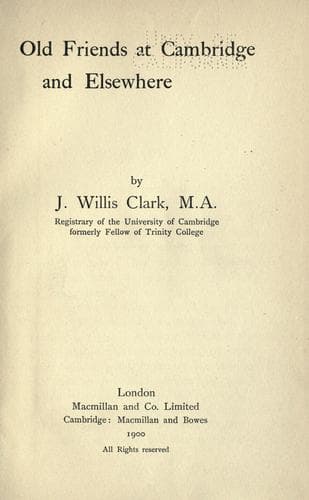
Old Friends at Cambridge and ElsewhereClark, John Willis
History
Old Friends at Cambridge and Elsewhere
Clark, John Willis
University of Cambridge -- History
white flower of a blameless life’ through a period when the customs
prevalent in the University were such as are more honoured in the breach
than in the observance.
He proceeded to the degree of Bachelor of Arts in 1816, when he was
second Wrangler and second Smith’s Prize-man. On both occasions he was
beaten by a Mr Jacob, of Caius College, who was his junior by two years.
It is a Cambridge tradition that Mr Jacob’s success was a surprise to
everybody, for he had intentionally affected to be an idle man, and
showed himself on most days riding out in hunting costume, the truth
being that he kept his books at a farm-house, where he pursued his
studies in secrecy and quiet. He was a young man of the greatest
promise; and it was expected that he would achieve a conspicuous success
at the Bar. But his lungs were affected, and he died of consumption at
an early age. As Mr Todhunter remarks, his fame rests mainly on the fact
that he twice outstripped so formidable a competitor as the future
Master of Trinity. Whewell mentions him as ‘a very pleasant as well as a
very clever man,’ and adds, ‘I had as soon be beaten by him as by
anybody else.’
The labours of reading for the degree over, Whewell had leisure to turn
his studies in any direction whither his fancy led him. No doubt he
fully appreciated the, to him, unusual position, for he tells his sister
that few people could be ‘more tranquilly happy than your brother, in
his green plaid dressing-gown, blue morocco slippers, and with a large
book before him.’ The time had come, however, when he was to experience
the first of the inevitable inconveniences of a College life. Two of his
most intimate friends, Herschel and Jones, left Cambridge, and he
bitterly deplores their loss. Indeed it probably needed all the
attachment to the place, which he proclaims in the same letter, to
prevent his following their example. He appears at one time to have
thought seriously of going to the Bar. He began, however, to take
pupils: an occupation which becomes a singularly absorbing one,
especially when the tutor takes the interest in them which apparently he
did. One of those with whom he spent the summer of 1818, in Wales, Mr
Kenelm Digby, afterwards author of the _Broadstone of Honour_, who
admits that he was so idle that his tutor would take no remuneration
from him, has recorded that—
‘I had reason to regard Whewell as one of the most generous,
open-hearted, disinterested, and noble-minded men that I ever knew. I
remember circumstances that called for the exercise of each of those
rare qualities, when they were met in a way that would now seem
incredible, so fast does the world seem moving away from all ancient
standards of goodness and moral grandeur.’
Public-domain text, read in full here on John Shaqi.
Reviews
Reviews
No reviews yet
Be the first to share your thoughts on this work.
Join the Discussion
Join the discussion
Sign in to leave a comment or review.
Sign InorCreate an account