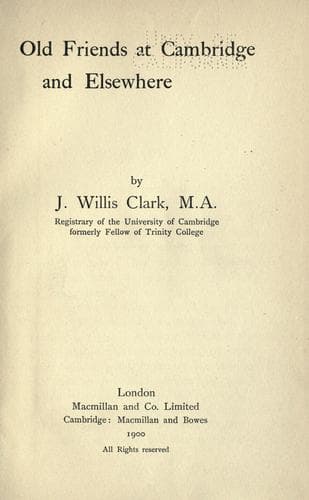
Old Friends at Cambridge and ElsewhereClark, John Willis
History
Old Friends at Cambridge and Elsewhere
Clark, John Willis
University of Cambridge -- History
above-mentioned, either directly or by their suggesting to him the study
of Schleiermacher, whose writings were first introduced to English
readers by their influence. That critic’s theory—that Plato had a
comprehensive and precise doctrine to teach, which he deliberately
concealed under the complicated machinery of a series of dialogues,
leaving his readers to combine and interpret for themselves the dark
hints and suggestions afforded to them—was followed by Thompson with
great learning, unerring tact, and firm grasp. His editions of the
_Phaedrus_ (1868) and the _Gorgias_ (1871) are models of what an
edition, based on these principles, ought to be; and the paper on the
_Sophistes_, long lost sight of in the _Transactions_ of the Cambridge
Philosophical Society, but republished in the _Journal of Philology_
(1879), is a masterpiece. Nor must we omit an introductory lecture on
the _Philebus_, written in 1855, and published in the same journal
(1882), which is a piece of literature as well as a piece of criticism;
or the learned and instructive notes to Archer Butler’s _Lectures on the
History of Ancient Philosophy_, the first edition of which appeared in
1855.
Thompson discharged the difficult duties of a college tutor with
admirable patience and discretion. Those who knew him imperfectly called
him cold, hard, and sarcastic; and his bearing towards his brother
Fellows gave occasionally, we must admit, some colour to the accusation.
But in reality he was an exceedingly modest man, diffident of himself,
reserved, and at first somewhat shy in the society of those whom he did
not know well. Again, it must be recollected that nature had dealt out
to him a measure of ‘irony, that master-spell,’ of a quality that a
Talleyrand might have envied. Hence, especially when slightly nervous,
he got into a habit of letting his words fall into well-turned sarcastic
sentences almost unconsciously. The most ordinary remark, when uttered
by him, became an epigram. We maintain, however, that he never said an
unkind word intentionally, or crushed anybody who did not richly deserve
it. For the noisy advocate of crude opinions, or the pretender to
knowledge which he did not possess, were reserved those withering
sentences which froze the victim into silence, and, being carefully
treasured up by his friends, and repeated at intervals, clung to him
like a brand. To his own pupils Thompson’s demeanour was the reverse of
this. At a time when the older men of the University—with the exception,
perhaps, of Professor Sedgwick—were not in sympathy with the rising
generation, he made them feel that they had in him a friend who would
really stand _in loco parentis_ to them. Somewhat indolent by nature, on
their behalf he would spare no trouble; but, on the other hand, he would
allow of no interference. ‘He is a pupil of mine, you had better leave
him to me,’ he would say to the Seniors, when an undergraduate on his
Public-domain text, read in full here on John Shaqi.
Reviews
Reviews
No reviews yet
Be the first to share your thoughts on this work.
Elsewhere in the archive
Join the Discussion
Join the discussion
Sign in to leave a comment or review.
Sign InorCreate an account