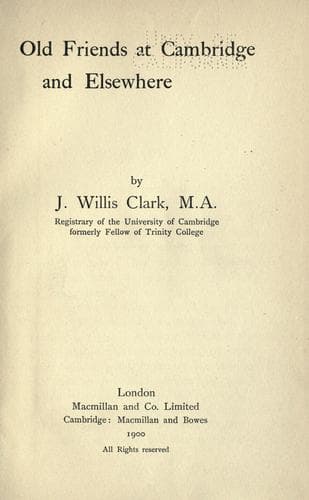
Old Friends at Cambridge and ElsewhereClark, John Willis
History
Old Friends at Cambridge and Elsewhere
Clark, John Willis
University of Cambridge -- History
Let it not be supposed, however, that Luard confined his attention in
literature to the classics. He was an insatiable reader of books on all
subjects, and if the book was a new one he was particular that his copy
should be uncut. He liked to read sitting in his armchair, and to cut
the leaves as he went along. What he began, he considered it a point of
honour to finish. It was a joke against him that he had read every word
of _The Cornhill Magazine_, which he had taken in from the beginning;
and I have heard him admit, more than once, that this was really the
case. I think it quite likely that he had submitted the volumes
published under the authority of the Master of the Rolls, to the same
searching investigation; for he could give a curiously minute account of
the merits and demerits of each work, supported, as usual with him, by
numerous quotations, cited with much volubility of utterance, and, it
may be added, with unerring accuracy. The pace at which he got through a
ponderous volume—without skipping, be it remarked—was really
astonishing, and when he had come to the end he could not only give a
clear and connected account of what he had read, but it became part of
himself, and he could quote long afterwards any passage that had
specially struck him.
The variety of Luard’s interests at all periods of his life, was
remarkable, especially when it is remembered that he was a genuine
student, with a horror of superficiality, and a conscientious
determination to do whatever he took in hand as well as it could be
done. But he was no Dry-as-dust. He was keenly alive to all that was
passing in the world, and unlike a contemporary Cambridge antiquary who
was once heard to ask, “Is the _Times_ still published?” he not only
read the paper through every day, but had his own very definite opinions
on men and measures. There was nothing narrow about him; he was a
patriotic Englishman, but he did not ignore the existence of the
Continent, and his favourite relaxation was foreign travel. As a young
man he had travelled extensively, not only in Europe, but in Egypt,
where he had ascended the Nile as far as the second cataract: and, as he
grew older, he still sought refreshment in going over parts of his old
tours, especially in those by-ways of Central Italy which lie within the
limits of what he affectionately called “dear old Umbria.” He spoke more
than one foreign language fluently; and, being entirely destitute of
British angularity, and British prejudices in politics and religion, he
always got on exceedingly well with foreigners, especially with foreign
ecclesiastics. I feel that I am saying only what is literally true when
I affirm that few Englishmen have understood the creed and the practice
of the Roman clergy in Italy so thoroughly as he did. In illustration of
this view I would refer my readers to an article called _Preaching and
other matters in Rome in 1879_ which he contributed to the _Church
Quarterly Review_[119].
Public-domain text, read in full here on John Shaqi.
Reviews
Reviews
No reviews yet
Be the first to share your thoughts on this work.
Elsewhere in the archive
Join the Discussion
Join the discussion
Sign in to leave a comment or review.
Sign InorCreate an account