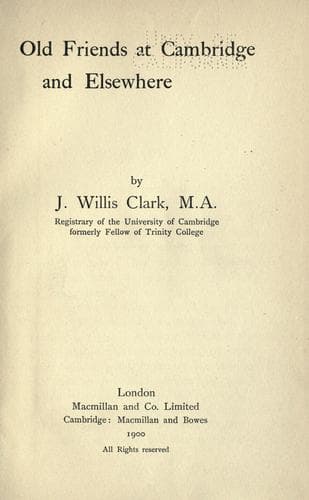
Old Friends at Cambridge and ElsewhereClark, John Willis
History
Old Friends at Cambridge and Elsewhere
Clark, John Willis
University of Cambridge -- History
Further, he took an intelligent interest in
antiquities of all sorts, and had an acquaintance with art that was
something more than respectable. Here his excellent memory stood him in
good stead, for he never forgot either a picture which he had once seen,
or the place in which he had seen it.
In politics he called himself a Tory, and he certainly did vote on that
side; but he was in no sense of the word a party-man. For instance, when
his friend Mr George Denman came forward as a Liberal candidate for the
representation of the University in 1855, Luard was an active member of
his committee. His knowledge of Italy made him watch the course of
events there in 1859 with an enthusiastic sympathy, which was divided
almost equally between the Italians and their French allies. With a
curious perversity, which was not uncommon in his appreciation of men
and his judgment of events, he hated Garibaldi as much as he admired
Victor Emmanuel and Cavour. But from the first he never doubted of the
cause of freedom, and astonished his Conservative friends by offering a
wager across the high table at Trinity as to the time it would take the
combined French and Italian forces to occupy Milan. So far as I can
remember, he was right almost to the very day.
From his boyhood Luard had been an ardent collector of books, and it was
probably this taste that induced him to take a further excursion into
the past, and begin the study of manuscripts. Professor Mayor tells me
that the influence and example of Dr S. R. Maitland turned his attention
to the Middle Ages in the widest sense—their history, their literature,
and their life. This may well have been the case, for I know, from many
conversations, that he had the profoundest respect and admiration for Dr
Maitland’s character, and for the thoroughness of his studies and
criticisms. I do not know how Luard acquired his very accurate knowledge
of medieval handwriting; but I remember that in 1855 or 1856 he gave me
some lessons of the greatest value. In the second of these years the
first volume of the Catalogue of Manuscripts in the University Library
was published, into the preparation of which he had thrown himself with
characteristic enthusiasm. As time went on, the direction of the work
was left more and more to him; he became the editor, and to him the
excellent index, published in 1867, is mainly, if not entirely, due.
Public-domain text, read in full here on John Shaqi.
Reviews
Reviews
No reviews yet
Be the first to share your thoughts on this work.
Elsewhere in the archive
Join the Discussion
Join the discussion
Sign in to leave a comment or review.
Sign InorCreate an account